
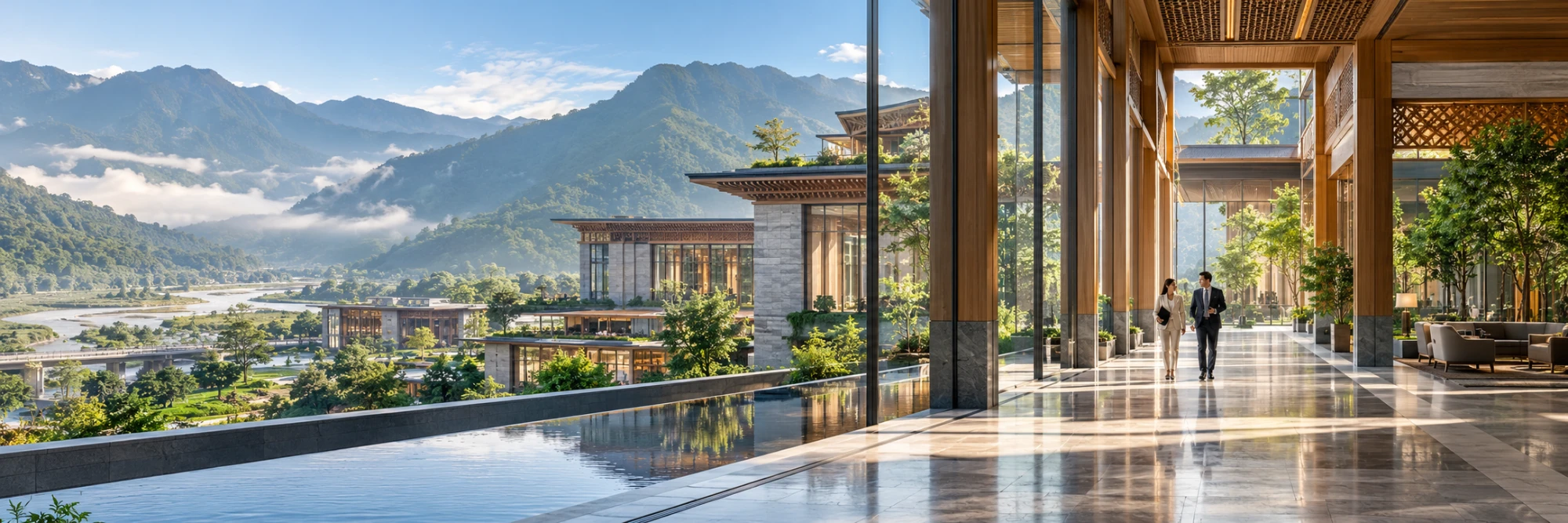
Contents
- 01. Overview
- 02. Name and concept
- 03. History
- 04. Geography and location
- 05. Government and administration
- 06. Law and legal system
- 07. Economy and the eight priority sectors
- 08. Company registration
- 09. Financial services and the central bank
- 10. Digital assets, Bitcoin and gold
- 11. Taxation and customs
- 12. Masterplan and city development
- 13. Airport, transport and borders
- 14. Energy, technology and industry
- 15. Spiritual foundations
- 16. People and community
- 17. Visiting Gelephu
- 18. Immigration, visas and passes
- 19. International relations and partners
- 20. Recognition and media coverage
- 21. Leadership
- 22. Timeline
- 23. Glossary of Bhutanese and official terms
- 24. Frequently asked questions
- 25. Related guides
- 26. Sources and method
01Overview
Gelephu Mindfulness City is a new jurisdiction inside an existing country. Bhutan has kept its national laws and institutions for the rest of the Kingdom, and it has given the Gelephu region a separate legal and administrative system so that a city can be planned, regulated and financed there from the beginning. The Authority describes the region as a highly autonomous Special Administrative Region with full executive and legislative powers and an independent judiciary.
The project has two purposes that are stated together. The first is international. GMC is presented as a place that shows a different path of development, where spirituality, harmony with nature, innovation and commerce are planned as parts of one city. The second is national. The region is intended to act as a catalyst for administrative reform and economic advancement across Bhutan, and to create work and opportunity for Bhutanese people, particularly the young.
The city is at an early and active stage. Laws are in force, companies are registered, financial institutions are licensed, flights operate between Gelephu and Kolkata, the airfield for the new international airport is under construction, and more than twenty sacred sites have received Royal approval. On 1 November 2026 Bhutanese volunteers raised 108 chortens in a single day along the Mao River, and on the same day His Majesty signed a Royal Decree that gives the financial regulator a central banking mandate.
| Measure | Figure | As at |
|---|---|---|
| Area of the region | About 1 million acres, roughly 4,000 km² | Royal Charter, 2024 |
| Share of Bhutan's territory | About 10 per cent | 2024 |
| State land within the region | 94 per cent | December 2025 |
| Laws in force | Royal Charter and 13 Acts, with two amending Acts | November 2026 |
| Licensed financial institutions | 14 | 12 November 2026 |
| Approved sacred sites | 22 | May 2026 |
| Chortens raised in one day | 108, each 15 metres tall | 1 November 2026 |
| Nation Building Bond | Nu. 3.347 billion from 35,403 investors | June 2025 |
| Bitcoin Development Pledge | Up to 10,000 Bitcoin | 17 December 2025 |
| Airport runway | 3,000 metres | Opening December 2029 |
| Planned population | 200,000 residents | By 2045 |
| Data centre capacity target | More than 3 gigawatts | By 2035 |
02Name and concept
The name joins a place with an idea. Gelephu is an existing town in Sarpang district in southern Bhutan. “Mindfulness City” describes the kind of city that is being built around it. In the National Day address of 17 December 2023, His Majesty described the future region as a Mindfulness City, encompassing conscious and sustainable businesses
, inspired by Buddhist spiritual heritage and distinguished by Bhutanese identity. The official short form is GMC. The region is also referred to as the Gelephu Special Administrative Region.
Mindful Prosperity
The philosophy behind the city is called “Mindful Prosperity”. It rests on the view that development should continue, because prosperity matters to people, and that it should be carried out in balance with nature and with spiritual life. Mindfulness and prosperity are treated as two halves of one plan. The roadmap that follows from this idea names eight priority industries, which are described in the economy section below.
A Buddhist city
In the National Day address of 17 December 2025, His Majesty described the project as larger than a megacity or a special economic zone, and as the first Buddhist city for Bhutan and for the world. The address set out a threefold aspiration, expressed in traditional terms: a strong economy in the outer realm, prosperity for the people in the inner realm, and a strong spiritual foundation in the secret realm. This is why sacred sites, monasteries, retreat centres and pilgrimage trails are being established at the same time as roads, offices and the airport.
Relationship with Gross National Happiness
Bhutan is known for Gross National Happiness, the development philosophy associated with His Majesty the Fourth Druk Gyalpo. The 2024 National Day address described GMC as a way to carry that inherited philosophy into the future and to show that small countries can lead. The masterplan draws on the principles of Gross National Happiness as well as on Bhutanese culture and spiritual heritage.
Related guides: His Majesty's vision for Gelephu · What GMC is and how it works in 2026
03History
Announcement, 2023
His Majesty announced the establishment of the city on 17 December 2023, during the 116th National Day address, to an audience of about 30,000 people. The address presented a new economic hub in southern Bhutan that would use its location and its links to South and Southeast Asia to create opportunity for citizens through investment in green technology, education and infrastructure. His Majesty called it a People's Project and a nation-building effort for Bhutan's economy, security and future.
The three National Day addresses
Bhutan's National Day falls on 17 December. His Majesty has used the address on that day in three successive years to explain the purpose of the city, and the three speeches together are the clearest statement of why it exists.
- 2023116th National Day, Thimphu
- The announcement. His Majesty set out the plan for a Special Administrative Region at Gelephu that would be an economic hub with a favourable business environment and, at the same time, a Mindfulness City shaped by Buddhist heritage and Bhutanese identity. The address presented the project as a national effort that depends on the commitment of the people.
- 2024117th National Day, Thimphu
- The framework. His Majesty explained One Country, Two Systems and the Diamond Strategy, and said that the two systems are intended to converge. The address placed the city in the context of the Asian century and of South Asia's two billion people, named the airport as the priority for the following five years, and reported that Bhutanese living in Australia, the United States and Canada had pledged close to US$140 million towards it.
- 2025118th National Day, Bumthang
- The purpose. Speaking from the grounds of Wangduechhoeling Palace, His Majesty described the city as the first Buddhist city and as a gateway to Asia. The address explained the land structure, in which 94 per cent of the land is state land and landowners hold a stake, reported more than fifty applications from international companies and fourteen approved sacred sites, and announced that 10,000 Bitcoin would be allocated to the city as a long-term strategic reserve.
Charter and first institutions, 2024
The Royal Charter was granted on 10 February 2024. On 1 October 2024 His Majesty appointed the first Chief Executive Officer, Mun Leong Liew, and the first members of the Board of Directors, and the Board held its first meeting at Paro Dungkar Dzong. On the same day the architect Bjarke Ingels presented the concept masterplan at the Bhutan Innovation Forum in Paro. The former Prime Minister, Dasho Dr Lotay Tshering, was appointed Governor on 4 October 2024.
In December 2024 the region gained its first Founding Member, its first registered international company and its first law. Ming Z. Mei, co-founder of GLP, was named the first GMC Founding Member on 12 December. The architecture practice BIG signed an agreement in Thimphu on 16 December to open a South Asia office registered in GMC. The 117th National Day address on 17 December set out the Diamond Strategy. On 26 December the Authority announced GMC Law No. 1 of 2024, the Application of Laws Act 2024.
Laws, finance and construction, 2025
The year 2025 was described by the Authority as Phase 0. The region published its key laws, built its investment and business frameworks, advanced detailed masterplanning and began the airport project. In January the Authority announced that Bitcoin, Ether and BNB would be recognised as part of the region's strategic reserves. In May the Gelephu Investment and Development Corporation launched the GMC Nation Building Bond, which raised Nu. 3.347 billion from 35,403 Bhutanese investors for the airport. The first eight spiritual projects received Royal Edicts in May.
Construction of Gelephu International Airport began with a ceremony on 8 July 2025. Thousands of citizens took part in volunteer programmes through the year. In November His Majesty appointed Seow Hiang Lee and Yee Ean Pang as Co-Chief Executive Officers, DK Bank received the first banking licence in the region, and the masterplan received a 2025 Holcim Foundation Award. The first international flight from Gelephu left for Kolkata on 8 December. On 17 December Bhutan announced the Bitcoin Development Pledge and launched TER, a gold-backed digital token.
A working jurisdiction, 2026
During 2026 the legal and financial system widened. Six commercial statutes were enacted after a public consultation in April. Bhutan and Singapore signed a double taxation agreement on 12 May, with the participation of the Authority. An accelerated licensing pathway opened for financial firms that are already licensed in leading financial centres, and a framework for family offices and investment funds took effect on 1 October. The register of licensed financial institutions reached fourteen firms by 12 November.
The built city advanced in the same period. The airfield contract for the international airport was awarded on 3 October, an immigration terminal with automated e-gates opened on 22 October, and the design of the first phase of Gelephu Old Town was commissioned. On 21 February, His Majesty's birth anniversary, the Ugyen Norlha Chorten was consecrated and ground was broken for the 80-metre Gelephu Chorten. On 1 November, 108 Jangchub Chortens were raised in one day, and His Majesty signed the Royal Decree that turns the financial regulator into the Gelephu Central Bank.
A dated list of events appears in the timeline.
04Geography and location
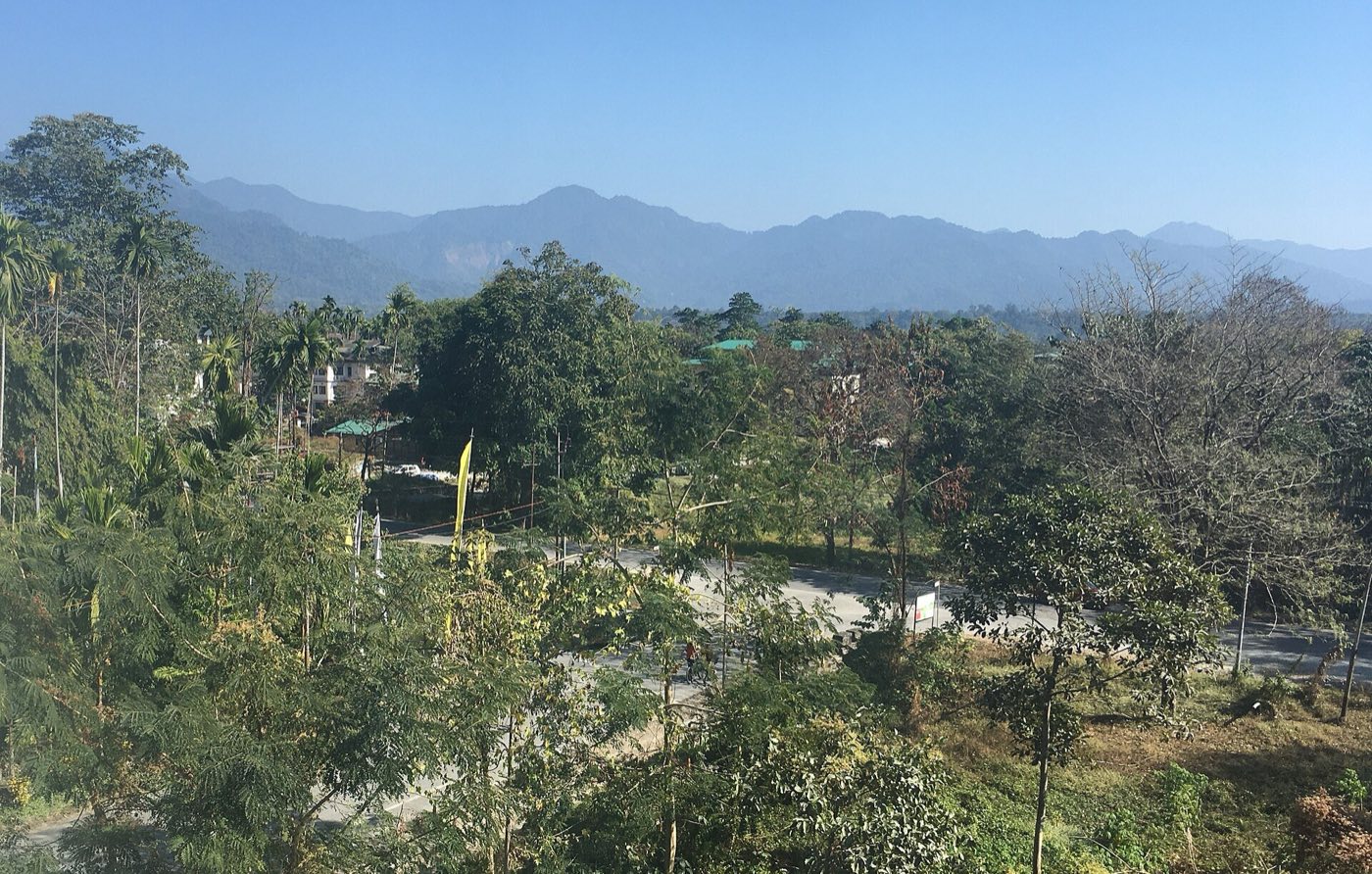
GMC lies on Bhutan's southern plains, where the Himalayan foothills descend to the plains of the Brahmaputra basin. It borders the Indian state of Assam. Most of Bhutan is mountainous, and the lowland around Gelephu is one of the few places in the country with wide, flat land. The climate is warmer and more tropical than in the valleys of western and central Bhutan.
The region spans about one million acres, which is roughly 4,000 square kilometres and about ten per cent of Bhutan's territory. The masterplan prepared by BIG, Arup and Cistri covers more than 2,500 square kilometres of that area. According to the 2025 National Day address, 94 per cent of the land within GMC is state land, and much of the private land belongs to rural families.
Rivers and landscape
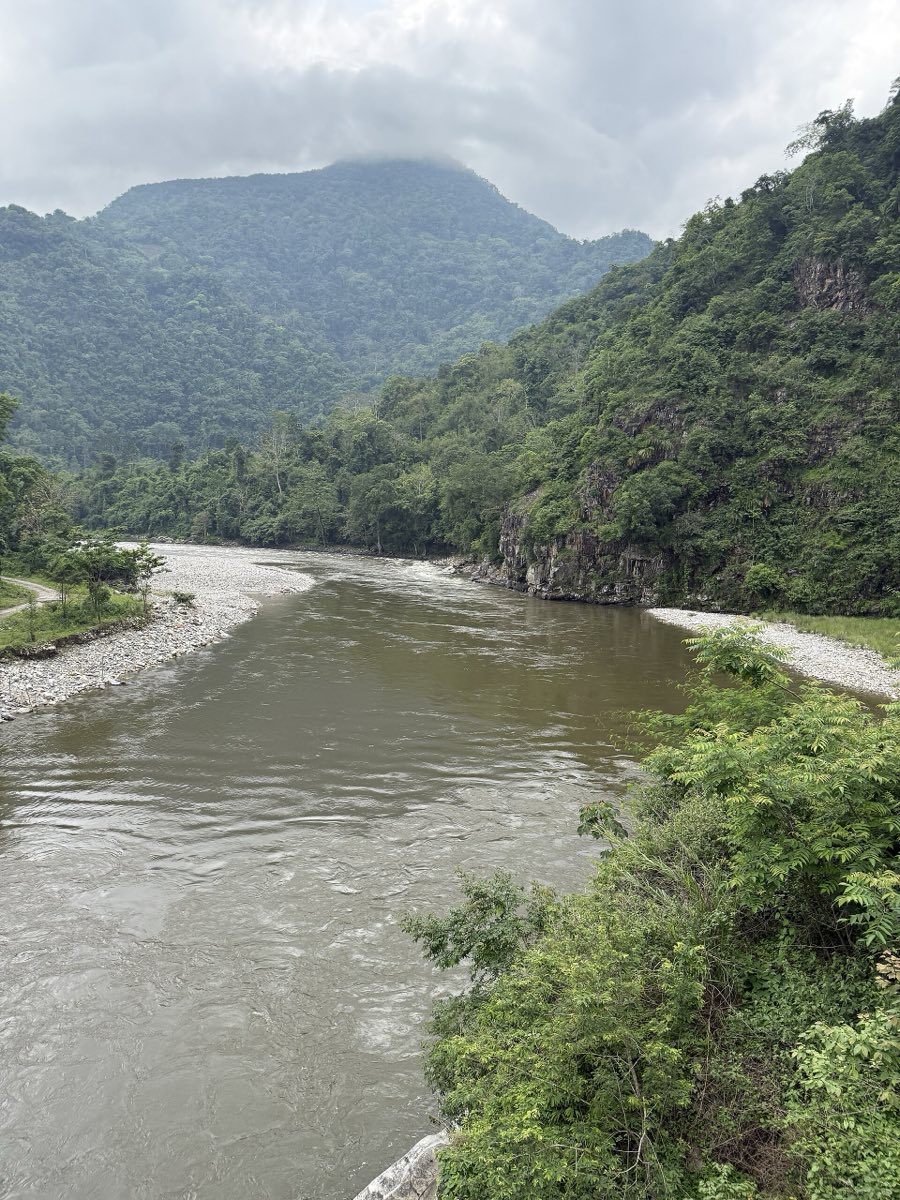
Several rivers cross the area on their way to the plains. The Mao River runs through Gelephu, and a 12-kilometre stretch of its banks carries the line of 108 chortens. The Paitha River crosses the site of the international airport, where a culvert system keeps its flow beneath the runway. The masterplan gives the rivers a central place in the identity of the city, with bridges across Gelephu's many winding rivers, one of which carries the airport runway.
Wildlife and protected areas
The region borders two of Bhutan's protected areas, the Phibsoo Wildlife Reserve and the Royal Manas National Park. An elephant corridor on the northern fringe of the planned golf course is protected by the Authority, and the forest there is home to the endangered golden langur. In February 2026 volunteers cleared a 230-acre habitat, planted fodder, dug water holes and made salt licks, and a herd of wild elephants began to use it within weeks.
Position in the region
Gelephu sits on a land bridge between South Asia and Southeast Asia. India is across the border, and His Majesty has pointed out that India and China together hold more than a third of the world's population. The Authority describes access to the Indian market, and to India's roads, railways and inland waterways, as one of the main advantages of the location. Entry by land is through the border crossing at Gelephu, which meets the Dadgari crossing on the Assam side.
Part II
The state
A jurisdiction with its own government, laws and courts, inside the Kingdom of Bhutan.
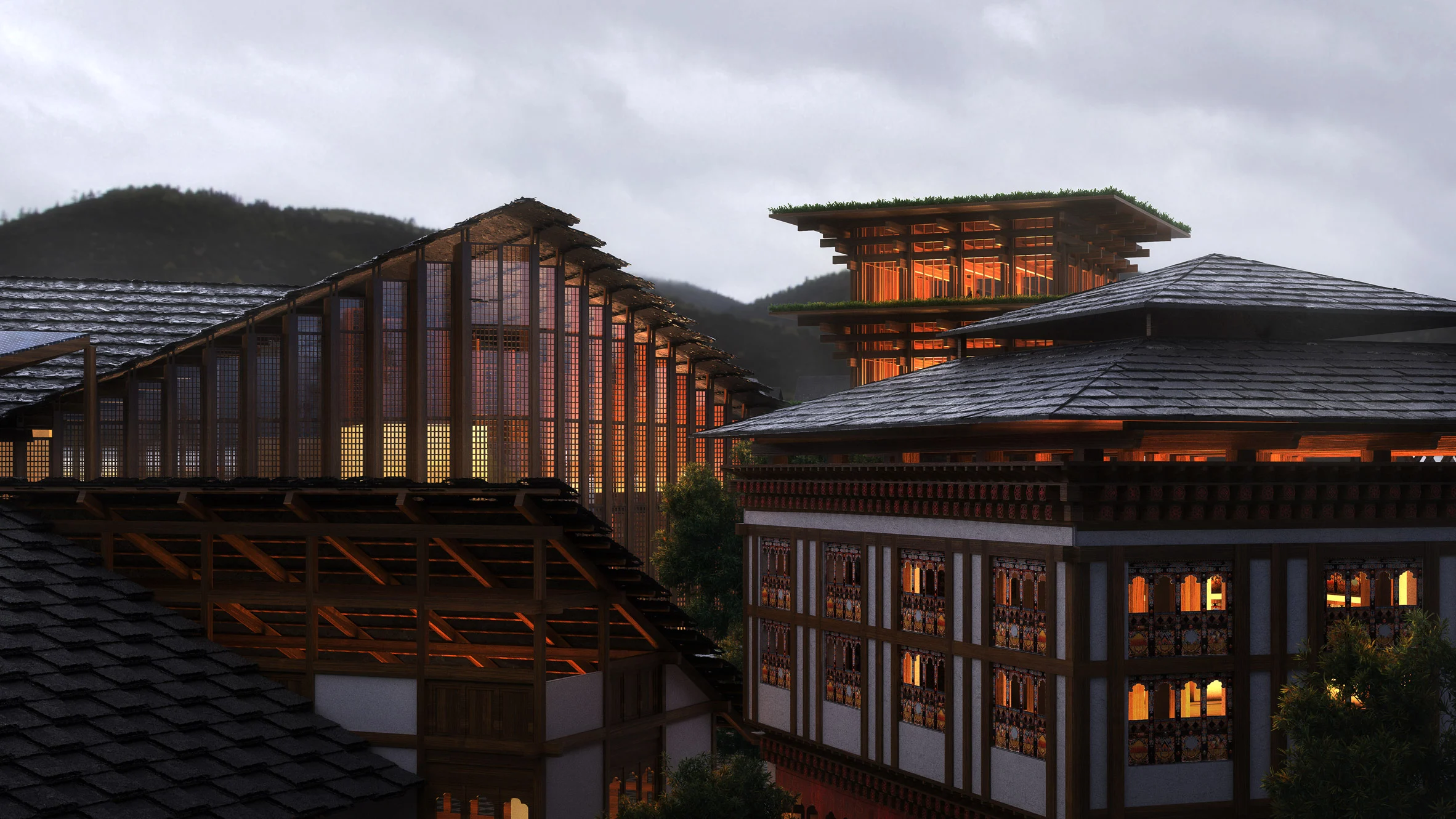
Concept image: BIG (Bjarke Ingels Group). Illustrative.
05Government and administration
A Special Administrative Region
GMC was established by Royal Charter as a Special Administrative Region. The Royal mandate gives it full executive and legislative powers and an independent judiciary, so that it is governed separately from the Royal Government of Bhutan while remaining part of the Kingdom. This arrangement is called “One Country, Two Systems”. The autonomy allows the region to adopt systems that have worked elsewhere and to test new ideas in a controlled setting.
The Diamond Strategy
The long-term relationship between GMC and the rest of Bhutan is set out in what His Majesty has named the Diamond Strategy. From 2025 the two jurisdictions follow different paths for about two decades. GMC builds an advanced economy from the ground up, and Bhutan continues its own development and reform. From 2045 the two are expected to move together again, with the aim of becoming one advanced economy under “One Country, One System” by 2065. The two sides coordinate throughout so that policies can be harmonised when needed. The shape of the two paths, which part and then meet, gives the strategy its name.
The 2024 National Day address linked this convergence to reforms in the rest of the country. His Majesty set a period of ten years for building what the address called an enlightened entrepreneurial bureaucracy and for establishing one of the best legal systems in the world, and spoke of strengthening democracy with meritocracy, improving laws and reforming education.
The Gelephu Mindfulness City Authority
The governing body is the Gelephu Mindfulness City Authority, known as GMCA. Its Board of Directors is chaired by His Majesty the King. The Board includes Bhutanese and international members with experience in airports, infrastructure investment, technology, education, conservation, housing, law and digital assets. Day-to-day leadership rests with two Co-Chief Executive Officers. The Governor leads domestic implementation, is the primary domestic authority, and reports to the Board.
- Board of DirectorsChaired by His Majesty the King
- Sets direction for the region. Founding Members, who are invited individually, act as advisers to the Board.
- Governor's OfficeDasho Dr Lotay Tshering
- Leads implementation within Bhutan, including compliance and enforcement, community programmes and training for households affected by projects.
- City DevelopmentMasterplan and construction
- Prepares and implements the masterplan, sets building codes and land-use rules, manages construction, housing, estates, infrastructure and the earthworks for the airport, and integrates spiritual and cultural projects.
- Economic Development GroupInvestor support
- Leads strategy and investment promotion and runs a single point of contact for investors, covering land identification, leases, incorporation, clearances, coordination with agencies, visas, employment and aftercare.
- International AffairsExternal relations
- Handles diplomatic engagement, external affairs and trade policy, including the negotiation of inter-governmental agreements and memoranda of understanding.
- Gelephu Corporate Registration OfficeGCRO
- The registry through which companies and other business entities are incorporated and registered.
- Gelephu Financial Services OfficeGFSO, becoming the Gelephu Central Bank
- Licenses, regulates and supervises financial services and virtual asset activity. A Royal Decree of 1 November 2026 confers a central banking mandate.
- Gelephu Investment and Development CorporationGIDC
- The investment arm of the Authority, established under a Royal Charter. It issued the Nation Building Bond and invests in green energy and digital infrastructure.
The Authority has offices in Gelephu and in Thimphu. The Thimphu office, on Norzin Lam, was inaugurated on 30 August 2025. Board members and senior officers are listed in the leadership section.
Related guides: Is GMC a separate jurisdiction? · How GMC differs from a free zone · The legal and governance framework
06Law and legal system
GMC has its own body of law. The system follows common law principles, which are familiar to businesses and lawyers in many of the world's commercial centres. Statutes cover companies, partnerships, employment, tax, customs, commercial contracts and financial services. The courts of the region are independent, and the framework provides for international commercial arbitration. Courts in GMC can rely on precedents from established common law jurisdictions.
The first statute was the Application of Laws Act 2024, enacted with the assent of His Majesty and announced on 26 December 2024. It is the Act that determines which laws apply in the region and how they apply. Further Acts followed in 2025 and 2026. The Authority consults the public on draft legislation. A consultation on six commercial statutes ran for two weeks and closed on 20 April 2026, and all six were then enacted.
| Law | Number | What it covers |
|---|---|---|
| Royal Charter | No. 1 of 2024 | Establishes the Special Administrative Region and its powers. |
| Application of Laws Act 2024 | Law No. 1 of 2024 | Sets out which laws apply in the region. Amended in 2025 and 2026. |
| Companies Act 2025 | Law No. 1 of 2025 | Formation, governance and administration of companies. |
| Customs Act 2025 | Law No. 2 of 2025 | Import, export and customs control. |
| Employment Act 2025 | Law No. 3 of 2025 | Terms and conditions of employment. |
| Employment of Foreign Workforce Act 2025 | Law No. 4 of 2025 | Work passes and the employment of foreign nationals. |
| Financial Services Act 2025 | Law No. 5 of 2025 | Licensing and regulation of financial services and virtual assets. |
| Income Tax Act 2025 | Law No. 6 of 2025 | Income tax on companies and individuals. Commencement notified in 2026. |
| Business Names Registration Act 2026 | Law No. 1 of 2026 | Registration of persons carrying on business and of their business names. |
| Limited Liability Partnerships Act 2026 | Law No. 2 of 2026 | Limited liability partnerships, a structure often used by professional firms. |
| Limited Partnerships Act 2026 | Law No. 3 of 2026 | Limited partnerships, a structure often used for investment funds. |
| Partnership Act 2026 | Law No. 4 of 2026 | Formation, operation and dissolution of general partnerships. |
| Sale of Goods Act 2026 | Law No. 5 of 2026 | Contracts for the sale of goods, including the passing of ownership and risk. |
| Unfair Contract Terms Act 2026 | Law No. 6 of 2026 | Limits on contract terms that exclude or restrict liability. |
Financial services rulebooks
The Financial Services Act 2025 is a single statute for the whole financial sector. Detailed requirements sit in rulebooks issued under it. There are ten rulebooks and one guidance document: the General Rulebook, the Conduct of Business Rulebook, two Prudential rulebooks for banking and investment business and for insurance business, the Captive Insurance Business Rulebook, the Fund Rulebook, the Market Rules, the Market Infrastructure Rulebook, the Anti-Money Laundering and Sanctions Rulebook, the Glossary Rulebook, and the Virtual Asset Guidance. Anti-money laundering is also governed by the AML/CFT/CPF Act 2026 and the regulations made under it.
| Rulebook | Short name | Subject |
|---|---|---|
| General Rulebook | GEN | Baseline requirements for every licensed firm: governance, conduct, authorisation, supervision and internal controls. |
| Conduct of Business Rulebook | COBS | How firms deal with clients: classification, disclosure, suitability, conflicts of interest and client assets. |
| Prudential Rulebook for investment, insurance intermediation and banking | PRU | Capital adequacy, credit, market, operational and liquidity risk, supervisory review and disclosure. |
| Prudential Rulebook for insurance business | PIN | Capital, solvency, risk management, governance and reporting for insurers. |
| Captive Insurance Business Rulebook | CIB | Rules for captive insurance business. |
| Fund Rulebook | FUNDS | Management, operation and marketing of investment funds, including domestic and foreign funds and prospectus disclosure. |
| Market Rules | MKT | Capital markets, securities offerings, listings on the Official List, disclosure and market conduct. |
| Market Infrastructure Rulebook | MIR | Exchanges, clearing houses and other recognised market bodies. |
| Anti-Money Laundering and Sanctions Rulebook | AML | Duties of firms and authorised persons in relation to money laundering and sanctions. |
| Glossary Rulebook | GLO | The defined terms used across all rulebooks. |
| Virtual Asset Guidance | Guidance | Additional guidance for firms that carry on virtual asset activity. |
Other rules in force
The region has its own data protection law, which applies to the processing of personal information, including health data. Subsidiary notices deal with tax and customs matters such as the treatment of Bhutanese products and alcohol. Businesses that existed in Gelephu before the new registry opened are migrated to the GMC business registration system.
Related guides: GMC Law Library · Which law applies in GMC? · Courts, arbitration and enforcement · GMC Legal Glossary
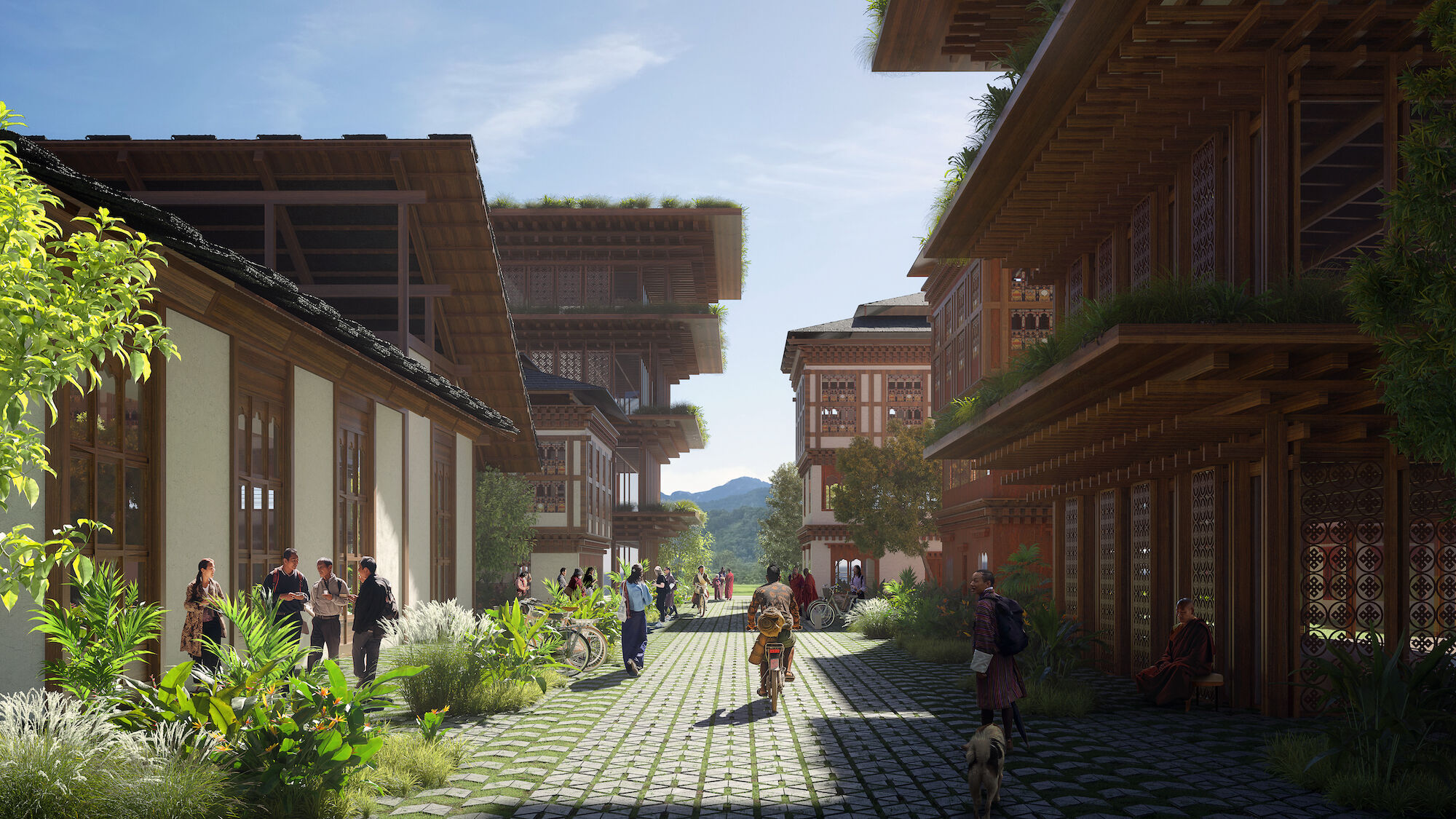
Part III
The economy
Eight priority sectors, one financial regulator, and a tax system written for international business.
Concept image: BIG (Bjarke Ingels Group). Illustrative.
07Economy and the eight priority sectors
The economic plan for GMC is organised around eight priority industries. Early statements named seven, and tourism was added as the eighth during 2025. The sectors were chosen to fit the idea of Mindful Prosperity, which means that each one is expected to create value while respecting nature, culture and wellbeing.
Spirituality
Sacred sites, monasteries, retreat centres, pilgrimage trails and institutions of Buddhist learning, open to several traditions.
Spiritual sector: legal advisoryHealth and wellness
Clinical services, diagnostics, longevity and regenerative medicine, and wellness retreats that draw on Bhutanese traditions.
Health and wellness: legal advisoryEducation and knowledge
Schools, universities, research centres and training institutions, including the Bhutan Baccalaureate curriculum.
Education and knowledge: legal advisoryAgri-tech and forestry
Technology for farming, food processing and sustainable forestry in a region with abundant land and forest.
Agri-tech and forestry: legal advisoryGreen energy and technologies
Hydropower, solar, battery storage, clean manufacturing and data centres that run on renewable electricity.
Green energy: legal advisoryFinance and digital assets
Banking, payments, funds, family offices, insurance, custody, exchanges and tokenised assets under one regulator.
Finance and digital assets: legal advisoryAviation and logistics
The international airport, air cargo, and road, rail and waterway links that connect Gelephu with India and the wider region.
Aviation and logistics: legal advisoryTourism
Slow, low-impact travel built on nature, culture, festivals, pilgrimage and wellbeing.
Tourism: legal advisory
Why investors look at Gelephu
The Authority points to four structural advantages. The first is energy. Bhutan generates hydropower in quantities that exceed domestic demand at certain times, and the country has set a target of 25 gigawatts of installed capacity by 2040 under its National Energy Policy 2025. The second is land, which is scarce in the rest of the country and available on the southern plains. The third is market access, because Gelephu is on the Indian border and Bhutan has close ties and favourable agreements with India. The fourth is a legal and tax system that international businesses recognise.
Support for investors
The Economic Development Group offers what the Authority calls a one-stop shop. It helps investors identify land plots, understand lease terms, incorporate companies, obtain regulatory clearances, coordinate with government agencies, arrange visas and employment passes, and receive support after they have set up. The Authority offers flexible long-term leases. By December 2025 the region had received more than fifty applications from international companies, and seventy buildings in the existing town were being renovated as offices.
Related guides: The eight priority sectors · Founder's guide to doing business in GMC · How to start a business in GMC · Every entity you can form in GMC
08Company registration
Companies and other business entities are registered by the Gelephu Corporate Registration Office, known as GCRO. The office is established under Article 4(2) of the Royal Charter and acts under the Companies Act 2025, the Business Names Registration Act 2026 and the partnership statutes of 2026. It oversees the formation, registration and continuing compliance of every entity in GMC, and it keeps the central public register. The whole process is carried out online.
Seven kinds of entity
| Entity | What it is | Registration fee |
|---|---|---|
| Private company limited by shares | A separate legal entity owned by shareholders, each liable up to the value of their shares. | US$2,000 |
| Public company limited by guarantee | A separate legal entity whose members guarantee a contribution on winding up in place of holding shares. | US$500 |
| Branch of a company | An extension of an existing company, foreign or already in GMC. The parent remains fully liable. A company registered elsewhere in Bhutan counts as a foreign company for this purpose. | US$2,000 |
| Limited liability partnership | A separate legal entity in which all partners may manage the business and each partner's liability is limited to the agreed contribution. | Set by the registry |
| Limited partnership | General partners manage the business with unlimited liability, and limited partners invest with liability limited to their investment. | Set by the registry |
| General partnership | Two or more people who share profits, management and responsibility, and who are jointly liable for the debts of the business. | Set by the registry |
| Sole proprietorship | A business owned by one individual, who carries all of its rights and liabilities. | US$250 |
Registration is renewed each year on the anniversary of incorporation. A special unique entity number can be requested for a one-time fee of US$3,000.
How a company is formed
- Expression of interest. The applicant describes what it intends to build in GMC. There is no fee and no account is needed at this stage.
- Business alignment assessment. GCRO reviews the proposal against the city's economic framework and its priority industries, and replies in writing.
- Appointment of a corporate service provider. The applicant appoints a provider from the panel, selects the entity type and reserves a name.
- Due diligence. The identities of subscribers and officers are verified through the corporate service provider.
- Incorporation form. Share capital, directors, the registered office and the constitution are filed together.
- Fee payment. The fee is paid online by card or in ngultrum through the national payment gateway.
- Certificate. The entity receives a digital certificate of incorporation, a certificate of registered business name and a unique entity number, and it appears on the public register.
GCRO publishes notices on its practice. Notices issued in January 2026 deal with the annual renewal of incorporation fees, the empanelment of corporate service providers and the waiver of the local director requirement under the Nominee Director Policy.
GCRO estimates that incorporation takes about one week from receipt of a complete set of documents. After incorporation the company appoints an auditor and keeps its legal status by lodging annual returns, maintaining its register of beneficial owners and submitting financial filings.
Requirements for a company
- Minimum paid-up capital
- US$1. Higher minimums apply to particular activities, such as regulated financial services, and to eligibility for certain tax incentives.
- Officers
- At least one director, one shareholder, one secretary and one auditor.
- Resident director
- One director must be ordinarily resident in GMC. The role can be held by an employee with a valid Employment Pass or by a Bhutanese citizen. A branch appoints a resident authorised representative to accept service of documents.
- Company secretary
- Appointed by the directors. The post may not stay vacant for more than six months. The secretary is a natural person resident in GMC, and the Registrar may waive the residence requirement.
- Data protection officer
- At least one, under the GMC Personal Data Protection Act.
- Name
- GCRO may refuse a name that is undesirable or identical to an existing registered business. Restricted terms include Bhutan, Druk, GMC, GMCA, Gelephu Mindfulness City, domain extensions, and words such as Royal or Government that need prior approval.
Corporate service providers
Since 1 November 2025, a corporate service provider is required for every new incorporation. Sole proprietorships owned by Bhutanese citizens are the exception. Providers are empanelled by the Authority, and a provider accepts an appointment before any work begins. The registry publishes the list of empanelled firms, and the current empanelment runs from 1 November 2025 to 1 October 2027.
Related guides: GMC company formation guide · How to incorporate a company in GMC · Substance requirements for a GMC company · Corporate service provider rules
09Financial services and the central bank
One regulator for the whole sector
The Gelephu Financial Services Office, known as GFSO, regulates all financial services and virtual asset activity carried out in or from GMC. Its remit covers banking, capital markets, payments, insurance, funds and digital assets. Traditional and virtual assets are regulated under the same statute, the Financial Services Act 2025, and the same rulebooks, with additional requirements for virtual asset business. A firm that wishes to carry on a regulated activity needs a Financial Services Licence before it begins.
From regulator to central bank
On 1 November 2026 His Majesty signed a Royal Decree that confers a comprehensive central banking mandate on GFSO, which becomes the Gelephu Central Bank. The bank operates as an autonomous central bank with a mandate to promote financial and price stability and to support the long-term development of the economy. Licensing and supervision continue within its Financial Supervision division.
The mandate allows the bank to conduct monetary policy, manage foreign reserves, oversee financial stability, provide liquidity support to the financial system, establish and oversee payment and settlement systems, issue central bank securities and develop money and capital markets. It may hold digital assets alongside conventional reserve assets. The Charter also provides a pathway for GMC to introduce its own currency, including in digital form, with His Majesty's concurrence. David Peters is the Managing Director.
How licensing works
The Financial Services Act lists the regulated activities in its first Schedule. GFSO's published guidance names twenty-seven of them, including accepting deposits, providing credit, dealing in investments, managing assets and funds, providing custody, providing money services, insurance business, operating a trading facility and issuing a fiat-referenced token, which is the activity that covers stablecoins.
- Initial contact and meeting. The applicant presents its business model and its reasons for choosing GMC.
- Application. GFSO invites a formal application, and a non-refundable fee is invoiced on submission.
- Review. GFSO assesses the application and may interview key personnel.
- In-Principle Approval. A successful applicant receives an approval that lists the conditions to be met before the licence is issued.
- Conditions. These include incorporating a company through the Gelephu Corporate Registration Office, opening a bank account, paying in regulatory capital, taking office space and hiring key staff.
- Licence. GFSO issues the Financial Services Licence and the firm may begin business.
GFSO states that successful applicants receive In-Principle Approval within six to eight months of submission on average, depending on the complexity of the business and the quality of the application. Licensed firms need a physical office in GMC, and the chief executive, compliance officer and money laundering reporting officer are resident there under GMC work visas.
| Regulated activity | Base capital (USD) | Application and annual fee |
|---|---|---|
| Accepting deposits (banks) | 10 million | US$35,000 each |
| Providing credit | 2 million | US$5,000 each |
| Dealing in investments as principal | 2 million | US$5,000 each |
| Issuing a fiat-referenced token | 2 million | US$5,000 each |
| Operating a multilateral or organised trading facility | 500,000 or 12 months of operating expenses, whichever is higher | US$50,000 each |
| Managing assets, providing custody other than for a fund, providing money services, dealing as agent or matched principal | 200,000 or 6 months of operating expenses, whichever is higher | US$5,000 each |
| Managing a collective investment fund | 150,000 | US$5,000 each |
| Advising and arranging activities, insurance intermediation, fund administration | 10,000 or 6 months of operating expenses, whichever is higher | US$5,000 each |
| Direct insurer | 4 million to 8 million | US$15,000 to US$25,000 each |
| Reinsurer | 20 million | US$15,000 to US$25,000 each |
Fees are charged per regulated activity. Where a firm applies for several activities, the capital requirement is the highest that applies among them.
The twenty-seven regulated activities
- Accepting deposits
- Advising on investments or credit
- Arranging deals in investments
- Acting as the administrator of a collective investment fund
- Acting as trustee of an investment trust
- Managing a collective investment fund
- Managing a venture capital fund and co-investments
- Arranging credit
- Providing credit
- Arranging custody
- Providing custody
- Dealing in investments as principal
- Dealing in investments as matched principal
- Dealing in investments as agent
- Carrying out contracts of insurance as principal
- Effecting contracts of insurance
- Insurance intermediation
- Insurance management
- Managing assets
- Providing money services
- Issuing a fiat-referenced token
- Operating a credit rating agency
- Operating a multilateral trading facility
- Operating an organised trading facility
- Providing trust services
- Administering a specified benchmark
- Providing information in relation to a specified benchmark
The documents in a licence application
- The application forms, with supplementary forms for banking, broker-dealer, asset management and insurance activities.
- A business plan for the GMC operation.
- A compliance manual that describes the firm's regulatory obligations and internal controls.
- An anti-money laundering manual covering money laundering, terrorist financing, proliferation financing and sanctions.
- The shareholding structure, including all controlling interests.
- An organisational chart.
- The curriculum vitae of the proposed chief executive, compliance officer, money laundering reporting officer and other key individuals.
- Transaction flow diagrams that show a typical transaction from beginning to end.
- Any further material that GFSO requests.
Accelerated pathway
In May 2026 the Authority introduced an accelerated licensing pathway for firms that already hold licences in leading financial centres, including Singapore, Abu Dhabi Global Market and Hong Kong. Incorporation, regulatory approval, bank account opening and the start of operations are handled as one coordinated process. Companies that obtain a licence are guaranteed a corporate account with DK Bank, with accounts in nine currencies and banking fees waived for at least the first six months.
Licensed institutions
GFSO keeps a public register of the firms it has approved. On 12 November 2026 the register listed fourteen active institutions. The first licence took effect on 3 July 2025.
| Institution | Regulated activities | Effective |
|---|---|---|
| Matrix Gelephu Pte Ltd | Dealing in investments as agent; custody | 3 Jul 2025 |
| DK Pte Ltd | Accepting deposits; credit; money services; dealing as agent and principal; custody; arranging deals; advising | 24 Nov 2025 |
| Matrix Bhutan Pte Ltd | Money services; dealing as matched principal; custody | 2 Feb 2026 |
| Oxygen7 Pte Ltd | Money services | 29 Apr 2026 |
| Ceffu Digital Pte Ltd | Custody; arranging credit; dealing as agent | 3 Jun 2026 |
| KairosX Gelephu Pte. Ltd. | Custody; money services; dealing as principal and agent | 6 Jul 2026 |
| 8020 Finance | Dealing as principal; custody; managing assets | 23 Jul 2026 |
| BTSE Exchange Pte. Ltd | Operating a multilateral trading facility; custody | 24 Jul 2026 |
| UKA PAY Pte Ltd | Dealing as agent; custody; money services | 6 Aug 2026 |
| Norlha Insurance Brokers Pte. Ltd | Insurance brokerage | 2 Sep 2026 |
| Spectrum Nexus Pte. Ltd. | Dealing as agent; money services; custody | 15 Oct 2026 |
| Royal Insurance Corporation of Bhutan Ltd. (Gelephu Branch) | Insurance and reinsurance | 28 Oct 2026 |
| Redotx (Boedra) Pte. Ltd. | Credit; money services; custody | 11 Nov 2026 |
| DK BTNX Pte. Ltd. | Issuing a fiat-referenced token (BTNX) | 12 Nov 2026 |
DK Bank
DK Bank is described as Bhutan's first digital bank and as the official bank of GMC. It holds licences from both the Royal Monetary Authority of Bhutan and the Gelephu authorities, and on 28 November 2025 it became the first bank licensed in the region. It offers accounts in US dollars, pounds sterling, euros, Australian dollars, yen, Singapore dollars, Indian rupees, Hong Kong dollars and ngultrum, together with digital asset services such as Bitcoin-backed lending and conversion between conventional currency and digital assets.
Family offices and investment funds
A framework for family offices, investment funds and fund managers took effect on 1 October 2026. A family office notifies GFSO of its plans. If it holds at least US$10 million in assets and meets a short list of conditions, the tax benefits follow without a separate application and without a licence. Funds pay no tax on income from designated investments for the life of the fund, up to fifteen years, and family offices receive the same exemption for up to fifteen years. The threshold is US$50 million for vehicles that invest in areas such as real estate, energy or infrastructure.
Fund managers pay tax at five per cent if they manage US$25 million or more and at ten per cent if they manage less, for up to twenty years. Managers approved before the end of 2027 pay no tax for the first five years, and carried interest is exempt. A manager that is already licensed in a recognised jurisdiction uses a no-objection process, to which GFSO responds within four weeks. A full GMC licence takes two to three months. The initial list of recognised jurisdictions is Singapore, Japan, Abu Dhabi Global Market, the Dubai International Financial Centre, Hong Kong and India.
Financial crime controls and cooperation
The Gelephu Financial Intelligence and Compliance Centre works within GFSO. It receives suspicious transaction reports and other mandatory reports, carries out initial analysis and refers cases to Bhutan's Financial Intelligence Department. Financial institutions and designated businesses and professions, which include lawyers, accountants, company service providers, real estate businesses and dealers in precious metals and stones, register with it. Non-profit organisations register as well. GMC is represented on Bhutan's national coordination committees for anti-money laundering policy.
The Royal Monetary Authority of Bhutan and GFSO signed a memorandum of understanding in Thimphu on 20 June 2026. It covers regulatory cooperation, the supervision of cross-border branches and subsidiaries, the exchange of financial intelligence and regular joint meetings. An earlier memorandum, signed in April 2025, links the Authority with the Financial Services Regulatory Authority of Abu Dhabi Global Market.
Related guides: Financial services licensing guide · Every regulated activity under Schedule 1 · The accelerated licensing pathway · Family offices and investment funds
10Digital assets, Bitcoin and gold
Digital assets are a formal part of GMC's economic plan and of its law. The background is Bhutan's hydropower. The country has used surplus renewable electricity to mine Bitcoin, and it is one of the larger sovereign holders of the asset. Bhutan's national digital identity system is anchored on a public blockchain and serves close to 800,000 citizens.
Strategic reserves
On 8 January 2025 the Authority announced that Bitcoin, Ether and BNB would be recognised as part of the region's strategic reserves, on the basis of their market capitalisation, liquidity and the maturity of their networks. GMC was among the first jurisdictions to hold digital assets officially in this way.
The Bitcoin Development Pledge
On 17 December 2025 Bhutan announced the Bitcoin Development Pledge. It commits up to 10,000 Bitcoin, valued at about US$1 billion at the time, to the long-term development of GMC. The pledge explains that the Bitcoin was produced with surplus clean energy and that it is held as a long-term national asset. Its stated aims are meaningful work for Bhutanese youth, new skills in technology, finance and clean industries, the chance for young people to build their lives at home, and stronger national financial resilience. In July 2026 the asset manager 3iQ was appointed to manage a mandate backed by part of the reserve.
TER, the gold-backed token
TER is a digital token backed by physical gold. Its name is the Dzongkha word for treasure. Each token represents 0.01 gram of fine gold of .9999 purity held in professional vaults. The Authority is the issuer, DK Bank is the exclusive distributor and custodian, and the token is issued on the Solana blockchain. TER was announced on 11 December 2025 and launched on 17 December. Holders can redeem tokens for 20-gram coins or one-kilogram bars, and the reserves are audited each quarter by independent firms. By February 2026 almost 100,000 Bhutanese citizens held TER.
Virtual assets under the licensing regime
Virtual asset firms are licensed under the same regime as other financial firms. GFSO assesses the assets that a firm proposes to offer against four criteria, which are traceability, security, market profile and the availability of liquidity venues. Bitcoin, Ether, BNB, USDC and USDT are generally treated as accepted virtual assets, and a firm may ask for a no-objection for others. Stablecoin issuers apply under the regulated activity of issuing a fiat-referenced token. Custodians, exchanges, payment firms and analytics companies have established or announced operations, among them Matrixport, Ceffu, BTSE, Bitget, Nansen, Cumberland DRW and Bitdeer.
Related guides: Crypto and digital assets guide · The 10,000 BTC pledge · The GMC digital asset framework · Is crypto legal in Bhutan?
11Taxation and customs
GMC has its own tax system under the Income Tax Act 2025. The Authority describes it as simple, predictable and competitive. The main features published by the Authority are set out below.
| Item | Rate or amount |
|---|---|
| Corporate income tax | 15% |
| Withholding tax on dividends | 0% |
| Withholding tax on interest | 10% |
| Withholding tax on royalties | 5% |
| Individuals: GMC tax residents who are citizens of Bhutan | Progressive rates from 5% to 15% on chargeable income above US$10,000 |
| Individuals: global talent accompanying foreign investment | Exempt until 31 December 2030 |
| Capital gains, dividends, inheritance | No tax |
| Goods and services tax | Not applied in GMC |
Companies can claim deductions and capital allowances, including an Industrial Building Allowance for capital spent on an industrial building or structure. Incentives include concessionary rates for Strategic and Development companies and incentives for priority sectors such as digital assets, hospitality and tourism, family offices, construction and logistics.
| Relief | Amount |
|---|---|
| Earned income relief | Up to US$1,500 |
| Deduction for spouse | US$1,500 |
| Deduction for children | US$500 for each child |
| Deduction for disabled dependents | US$500 for each dependent |
| Deduction for insurance or health contribution | 1% of gross salary |
| Deduction for participation in national volunteer programmes | US$100 in the year of participation |
| Deduction for home ownership | Up to US$2,000 |
Other features
- Territorial system
- Tax is based on a territorial approach of the kind used in several leading financial centres.
- Corporate tax
- The corporate income tax rate is 15 per cent. Qualifying companies in priority sectors can receive incentives that include a zero per cent rate, depending on the level of investment.
- Capital gains, dividends and inheritance
- There is no capital gains tax, dividend tax or inheritance tax.
- Foreign talent
- Tax exemptions for foreign talent run through 2030.
- Goods and services tax
- Bhutan introduced a goods and services tax of five per cent on 1 January 2026. It does not apply in GMC, which continues with its existing sales tax system.
- Bhutanese products
- From 1 February 2026 there is no sales tax on Bhutanese products brought into GMC, except for products with added sugar, which carry a flat rate of fifteen per cent. The concession runs to the end of 2027.
- Alcohol
- From 9 March 2026, sales tax on stronger alcohol above a set price fell from 100 per cent to 25 per cent, and customs duty on alcohol from third countries fell from 100 per cent to 40 per cent. Alcohol made in Bhutan is exempt from customs duty.
- Tax treaties
- Bhutan and Singapore signed an agreement for the avoidance of double taxation on 12 May 2026. It was signed on behalf of both the Royal Government of Bhutan and GMC.
Tax and customs administration
Taxpayers are served by the GMC Taxpayer Service Centre in Gelephu, and the tax administration issues notices on filing, including the filing of individual income tax returns for the years of assessment 2026 and 2027. Customs declarations for imports and exports are made through the GMC Electronic Customs Management System, an online system for registration, declarations, payment and the tracking of applications.
Detailed rates, exemptions and conditions are set out in the Income Tax Act 2025 and in notices issued by the GMC tax administration. The guides listed below explain them section by section.
Related guides: GMC Tax Guide · The GMC tax regime in full · The Bhutan and Singapore tax agreement · Importing and exporting through GMC
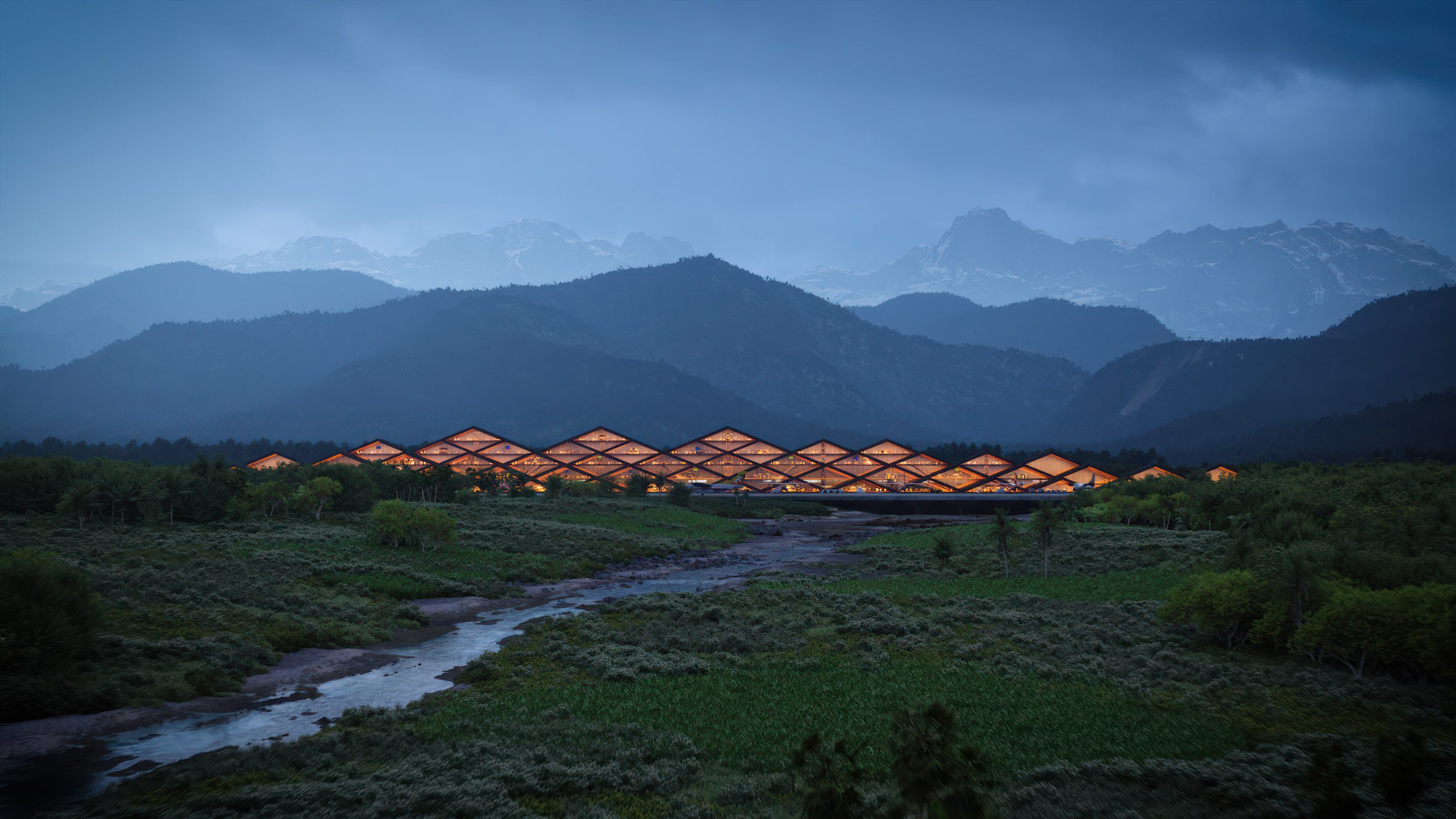
Part IV
The city
A masterplan between rivers, an international airport, and industries that run on clean power.
Concept image: BIG (Bjarke Ingels Group). Illustrative.
12Masterplan and city development
The masterplan for the city was designed by BIG, the practice founded by the Danish architect Bjarke Ingels, with the engineering firm Arup and the consultancy Cistri. Ingels presented the concept at the Bhutan Innovation Forum in Paro on 1 October 2024. The plan is informed by Bhutanese culture, by the principles of Gross National Happiness and by the country's spiritual heritage. Published descriptions refer to Bhutanese architectural wisdom, carbon neutrality and infrastructure that works with nature, and to bridges across Gelephu's many winding rivers.
BIG was also the first international company to register in GMC. In 2025 it presented work from the project at the Venice Architecture Biennale, and in November 2025 the masterplan was named a winner of the Holcim Foundation Awards for sustainable design and construction. The terminal design for Gelephu International Airport was named Future Project of the Year at the World Architecture Festival in 2025.


Gallery of concept images
The images below are concept images of the kind published for the masterplan. They show the intended character of the city: timber and stone, Bhutanese carpentry and colour, and buildings set low in the landscape. Select an image to enlarge it.
Phases of development
The Authority describes the growth of the region in phases that run from 2025 to beyond 2045.
- Phase 0January to December 2025
- The region's laws and policies were established, business and investment frameworks were created, detailed masterplanning advanced and the airport project began. The Authority opened offices in Thimphu and Gelephu, registered companies began operating from Gelephu, and the first spiritual sites and tourism programmes were launched.
- Phase 12025 to 2030
- By 2027, Gelephu's Old Town is revitalised with showcase commercial projects that turn the centre into a place to live and work. By 2030, the international airport and the railway connection with India are operational, and the city centre expands outwards for more investors, businesses and long-term residents.
- Phases 2 and 32030 to 2045
- A fifteen-year period in which the city grows to support 200,000 residents, with clusters established in all eight priority sectors.
- Phase 42045 onwards
- The transformations that allow GMC to become an advanced economy and to be recognised as the leading Mindfulness City in the world are completed.
Gelephu Old Town
The centre of the existing town is the first part of the city to be rebuilt. About forty buildings covering 36,000 square metres are being redeveloped as a connected urban centre with a Bhutanese identity. The Authority has appointed the Japanese firm Nikken Sekkei to lead the architectural and structural design of this first phase, which is expected to be complete by the end of 2028. The plan gives priority to walking and cycling, keeps and adapts selected existing buildings, and combines modern structural engineering with Bhutanese materials and craftsmanship.
Housing, schools and public facilities
The Authority has awarded a 1,000-bed workers' dormitory under a 25-year public-private partnership. It will open in two phases of 500 beds, the first in mid-2027 and the second at the beginning of 2028. Between 7,000 and 10,000 construction workers are expected each year at the peak of building. The Hathisar School, a primary school offering the Bhutan Baccalaureate from early childhood to grade six, is expected to open in February 2028. An 18-hole golf course of 270 acres, designed by Tom Doak, is planned on forested land in the south of the city and will be managed by the Royal Bhutan Country Club.
Related guides: Bhutan's model for mindful urban development · Land, leases and site acquisition · Real estate and construction: legal advisory
13Airport, transport and borders
Gelephu International Airport
The new international airport is the largest single project in the first phase of the city. His Majesty has called it a People's Project and has named it the first of three immediate priorities, together with the transformation of Gelephu town and the spiritual sector. It is designed to connect Bhutan with the world all year and in all weather, with a runway that takes longer-range aircraft and operates by day and night.
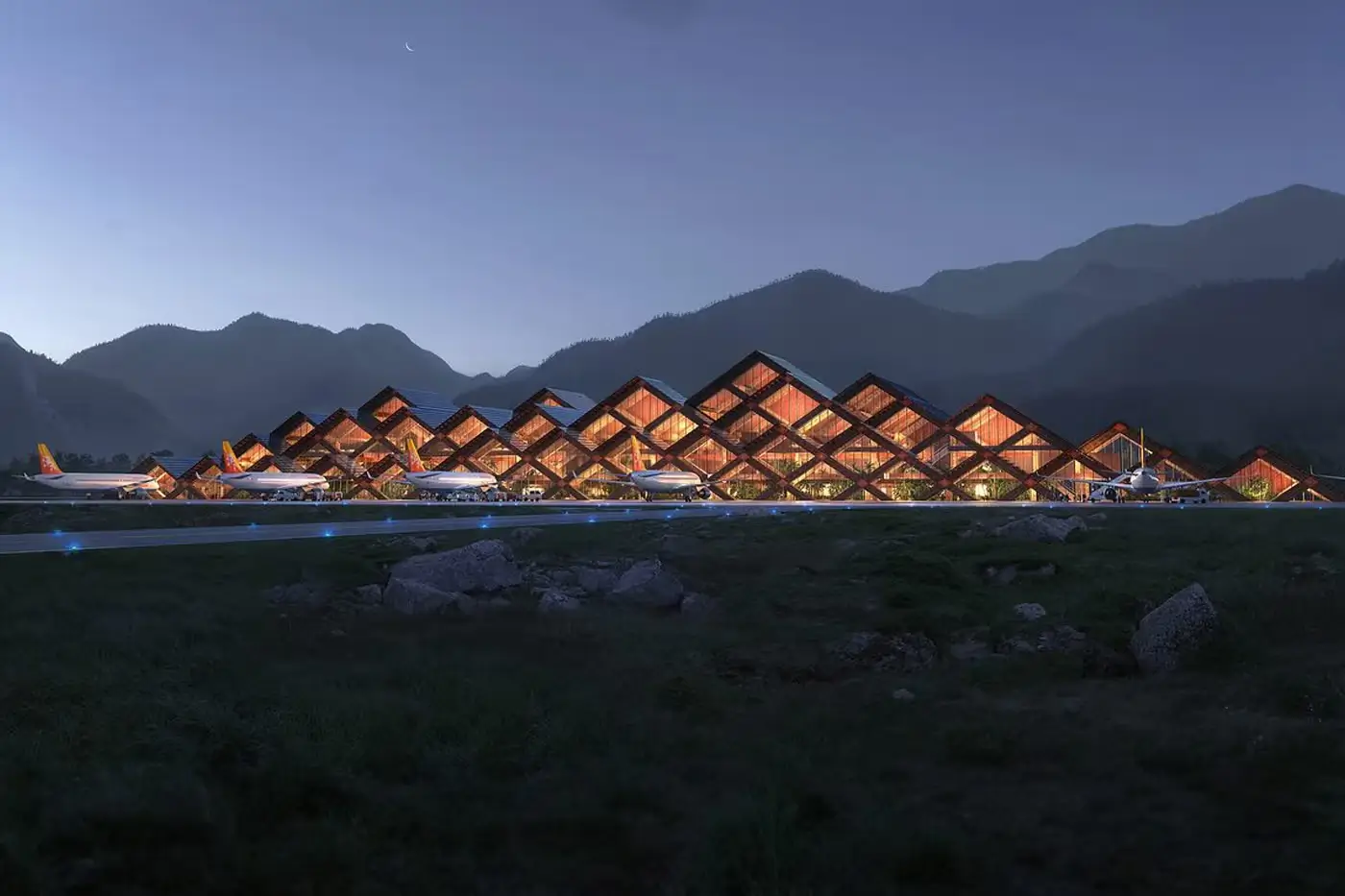
| Site | About 4 square kilometres across the Paitha River in Sarpang district |
|---|---|
| Runway | 3,000 metres, designed for narrow-body aircraft at opening and wide-body aircraft in the longer term, with an Instrument Landing System |
| Capacity | 1.3 million passengers a year at opening, expandable to 5.5 million and beyond |
| Terminal design | Timber structure inspired by Bhutan's four forest ecosystems, with passive ventilation |
| Construction began | 8 July 2025 |
| Airfield contract | Awarded to Rigsar-Vajra Joint Venture on 3 October 2026 |
| Opening | December 2029, with inauguration planned for 17 December 2029, Bhutan's National Day |
| Funding | Includes the GMC Nation Building Bond and pledges from Bhutanese living abroad |
The airfield contract covers the runway, taxiways, aprons, airfield lighting, the air traffic control tower and other airport systems. More than 800 workers are expected on site at the peak of construction. Thirty families whose land falls within the airport site have received rent support, school transfers and a training and enterprise programme run by the Governor's Office with the national employment department and UNDP Bhutan.
Flights today
Gelephu already has an airport. It received its aerodrome certificate in September 2023. The first international flight left for Kolkata on 8 December 2025, and Drukair has operated scheduled flights on the Gelephu and Kolkata sector since 12 December 2025. Drukair also links Gelephu with Paro, a flight of about 25 minutes. Both services operate on Mondays and Fridays, and helicopter services are available.
Road, rail and waterways
Gelephu is connected by road with the rest of Bhutan and with Assam. A railway connection with India is planned to be operational by 2030 under Phase 1. Through Bhutan's ties with India, the city can use the network of roads, railways and inland waterways that links the area with India and the wider region.
Immigration terminal
The GMC Immigration Terminal opened on 22 October 2026 at the land border. It has automated e-gates that allow eligible Bhutanese and Indian nationals to clear immigration by biometric verification when they cross on foot. Travellers who have not registered their biometrics use staffed counters. Facilities for nationals of other countries are being introduced in coordination with the Government of India.
Related guides: Aviation and logistics: legal advisory · Energy and infrastructure: legal advisory
14Energy, technology and industry
Clean electricity is the base of the industrial plan. Bhutan's power comes mainly from hydropower, and the Authority intends the city to become what it calls a Green Technology Valley, where renewable energy, digital infrastructure, research and talent are located together. The target is more than three gigawatts of data centre capacity in the city by 2035.
- AI data centresBitdeer and SATO Technologies
- In July 2026 the Authority signed a letter of intent with SATO Technologies for the phased development of an AI data centre campus powered by renewable energy. In October 2026 it signed a letter of intent with the Gelephu Investment and Development Corporation and Bitdeer Technologies Group for a second campus in the Green Technology Valley. Bitdeer is the first Corporate Founding Member of GMC.
- Battery manufacturingPatel Greentech
- In November 2026 the Authority signed a letter of intent with Patel Greentech, a clean-energy company from Gujarat, for a facility that assembles battery energy storage systems. It is planned in two phases with a capacity of up to ten gigawatt-hours a year, and it would be the first facility of its kind in Bhutan.
- HydropowerAdani and Druk Green Power
- Gautam Adani, chairman of the Adani Group, joined as a Founding Member in January 2026. On the same day Druk Green Power Corporation and Adani Power signed a memorandum to develop 5,000 megawatts of hydropower in Bhutan, and the foundation stone was laid for the 570-megawatt Wangchhu project.
- Health technologyKKH, Waive Diagnostics and Viome
- KK Women's and Children's Hospital in Singapore is technical adviser for an IVF centre, which will be Bhutan's first. Waive Diagnostics is setting up a genetic and diagnostic laboratory as its South Asia base. Viome Life Sciences, Druk Holding and Investments and GMC have agreed to explore a molecular foundation model, an AI system trained on molecular health data, with computing powered by hydropower.
- Professional servicesLaw, compliance and corporate services
- The Indian law firm Khaitan & Co signed a strategic memorandum with the Authority in November 2025. A Centre of Excellence for financial compliance trains Bhutanese compliance officers, and corporate service providers are appointed to a panel by the Authority.
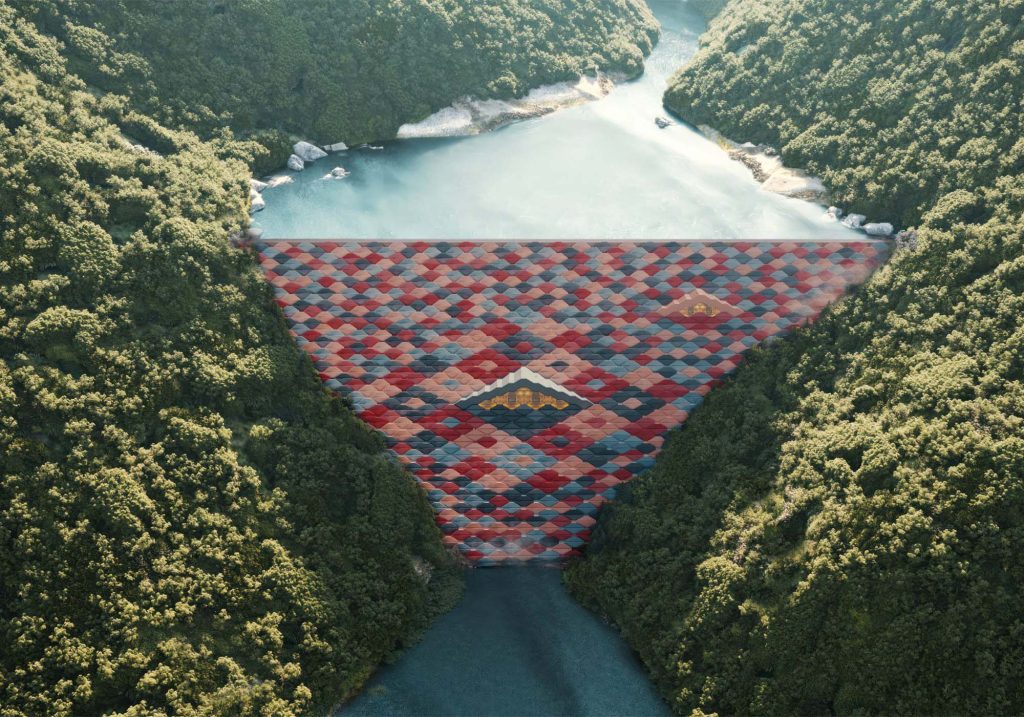
Part V
Sacred ground
Twenty-two sacred sites, an eighty-metre chorten, and 108 stupas raised in a single day.
Concept image: BIG (Bjarke Ingels Group). Illustrative.
15Spiritual foundations
Spirituality is treated as the foundation of the city. Bhutan is a Vajrayana Buddhist kingdom, and GMC draws on that living tradition while remaining open to other Buddhist schools and wisdom traditions. Sacred sites, retreat centres and institutions of learning are planned so that contemplation is part of everyday life. His Majesty introduced the terrain to Bhutanese spiritual leaders in November 2024, and within a year fourteen sacred sites had been designed, consecrated and begun.
A project becomes part of the city through a Royal Kasho, a Royal Edict issued by His Majesty that recognises it formally. Eight projects received a Kasho in May 2025 and three more in October 2025. Together with Royal Projects and a chorten built by the Central Monastic Body, these made up the first fourteen sites. Eight further projects received a Kasho in 2026, which brings the number of approved sacred sites to twenty-two. They are initiated by recognised lamas and trulkus, planned with the city's professionals, funded by devotees, and supported by voluntary labour.
| Project | Led by | Description |
|---|---|---|
| Gelephu Chorten | Royal Project | An 80-metre stupa modelled on the Jarung Khashor (Boudhanath) stupa in Nepal, and the centrepiece of the sacred sites. |
| Guru Nangsid Zilnon Lhakhang | Royal Project | A temple dedicated to Guru Rinpoche in the form of Guru Nangsid Zilnon. |
| Tabab Chorten | Royal Project, Central Monastic Body | A chorten that marks the entrance to the city. |
| Tashi Gomang Chorten | Lam Tshering Wangdi, under His Holiness the Je Khenpo | A landmark inspired by the Dorjidhen stupa at Bodh Gaya. |
| Gelephu Dzong (Shambhala Dzong) | Central Monastic Body of Bhutan | A training centre in the Garthik Yangsum tradition. |
| Geynyen Neykhang | Trulku Marp | A temple for Geynyen Jakpa Melen, the protector deity of Gelephu. |
| Barchey Kuensel Chorten | Khenpo Karma Wangchuk | The stupa that pacifies all obstacles, a symbol of peace and harmony. |
| Vajrakilaya Research Center | Zuri Trulku | A centre for the preservation of rare Buddhist scriptures and art. |
| Kurukulee Center | Gangtey Trulku Rinpoche | A centre for mindful walking and reflection based on sacred geometry. |
| Kesang Do Ngags Shedrupling | Shechen Rabjam Rinpoche | An institution for Buddhist studies up to doctoral level. |
| Kangyur Labyrinth | His Holiness Drikung Kyabgon | A contemplative labyrinth with the Kangyur at its centre. |
| Druk Ugyen Samye Ling | Namkhai Nyingpo Rinpoche | A monastery for contemplative practice. |
| Gelephu Maitreya Temple | Trulku Kunga Tenzin | A temple dedicated to Maitreya, the future Buddha. |
| Tara Retreat Center | Bhutan Tara Foundation | A sanctuary for Tara practice. |
The eight projects approved in 2026 are the Dewachen Spiritual Centre, the Druk Yoga and Mindfulness Centre, Jampal Gyepai Dangden, Kathok Zhithro Kilkhor, Menjong (a healing garden with the Medicinal Buddha), Peling Dzogchen Lingka, the Tendrel Nyensel Healing Centre and the Varahi Mandala. The Varahi Mandala is led by Khandro Dorji Phagmo, Bhutan's most prominent female reincarnate lama.
The Gelephu Chorten and the Ugyen Norlha Chorten
Ground was broken for the Gelephu Chorten on 21 February 2026, His Majesty's forty-sixth birth anniversary, in the presence of three generations of the Royal Family, His Holiness the Je Khenpo and more than 12,000 volunteers. On the same day the Ugyen Norlha Chorten was consecrated near the main gate from India. It is the first spiritual landmark completed in the city, and it is dedicated to Ugyen Norlha, the manifestation of Guru Rinpoche associated with prosperity.

The story behind the Gelephu Chorten
The Gelephu Chorten takes its form from the Jarung Khashor stupa in Kathmandu, which is known internationally as Boudhanath and is a World Heritage site. According to the account that Guru Padmasambhava gave at Samye in the eighth century, the original stupa was built in the age of the Buddha Kashyapa by a poor woman who kept poultry and her four sons. She asked the king for land, and his reply, which is remembered as “let it be done”, gave the monument its name.
The tradition holds that the four sons were reborn as the king Trisong Deutsen, the abbot Shantarakshita, Guru Padmasambhava and a minister, who together built Samye, the first monastery in Tibet. The story connects with Bhutan through the treasure revealer Pema Lingpa, who was born in Bumthang in 1450 and from whom the Wangchuck dynasty traces descent. Bhutan's first King, Ugyen Wangchuck, sponsored the last major reconstruction of the Boudhanath stupa in the early twentieth century, and His Majesty visited it in 2024. His Majesty commanded the construction of the Gelephu Chorten in 2023.
Inside the Ugyen Norlha Chorten
The Ugyen Norlha Chorten stands near the border as a greeting to people arriving from India. It was built by the Central Monastic Body and consecrated by His Holiness the Je Khenpo. It is dedicated to the deities of prosperity, and it also commemorates the birth of Her Royal Highness the Gyalsem. The southern wall shows forms of Dzambala, the protector of enlightened wealth, and the northern wall shows the Five Sister Deities of longevity and prosperity beside Buddha Shakyamuni and Zhabdrung Ngawang Namgyel, who unified Bhutan. The Four Great Kings stand near the entrance with Ganesh, Parvati, the Goddess of Fortune and Tara. The exterior carries thirty-four images each of the Buddha, Guru Rinpoche, Tara and Zhabdrung, and the top floor holds a thousand statues each of nine figures.
Places of learning
Several of the approved sites are institutions of study. Kesang Do Ngags Shedrupling, founded by Shechen Rabjam Rinpoche, offers programmes in Buddhist philosophy, epistemology, history, classical languages and the translation of texts, up to master's and doctoral level. The Kangyur Labyrinth, led by Drikung Kyabgon Chetsang Rinpoche, is a single continuous path that leads to the Kangyur, the collected words of the Buddha, at its centre. The Vajrakilaya Research Center preserves rare scriptures and art. The Authority has also referred to a Buddhist university, to research centres and to forums where contemplative traditions and modern science meet.
The 108 Jangchub Chortens
On 21 February 2026 His Majesty announced that Bhutan would raise 108 Jangchub Chortens, or stupas of enlightenment, in a single day. They were raised on 1 November 2026, a date that coincides with the descending day of Lord Buddha and the anniversary of His Majesty's coronation. Each chorten is fifteen metres tall. They stand in single file along the Mao River, 108 metres apart, over a corridor of about twelve kilometres. An estimated 40,000 volunteers took part, in the Bhutanese tradition of zhabto, which is work offered freely for the common good. The number 108 is auspicious in Buddhist tradition and stands for completeness.
The Lotus-Born Trail
The Lotus-Born Trail follows the route that Guru Rinpoche, also known as Padmasambhava, is said to have taken in the eighth century from the southern plains near Gelephu through Trongsa to the valley of Bumthang. Construction began in December 2025 with volunteers and Desuups, who cleared and reconnected old paths and built campsites, rest areas and bridges. The trail is planned with meditation shelters, interpretive centres, eco-lodges and homestays.
Other traditions and practices
The Shivalaya Yagyaswar Mahadev Mandir, a Hindu temple given by His Majesty in 2018, is being gilded as the Golden Mandir at His Majesty's command. In October 2026 His Majesty opened a digital platform for Yoeja, the Bhutanese tradition of offering alms in support of prayer, so that people around the world can take part. The Central Monastic Body has committed to performing a national prayer ceremony, the kurim, throughout the project, and about 700 monks have offered voluntary labour.
Related guide: Spiritual sector in GMC: legal advisory
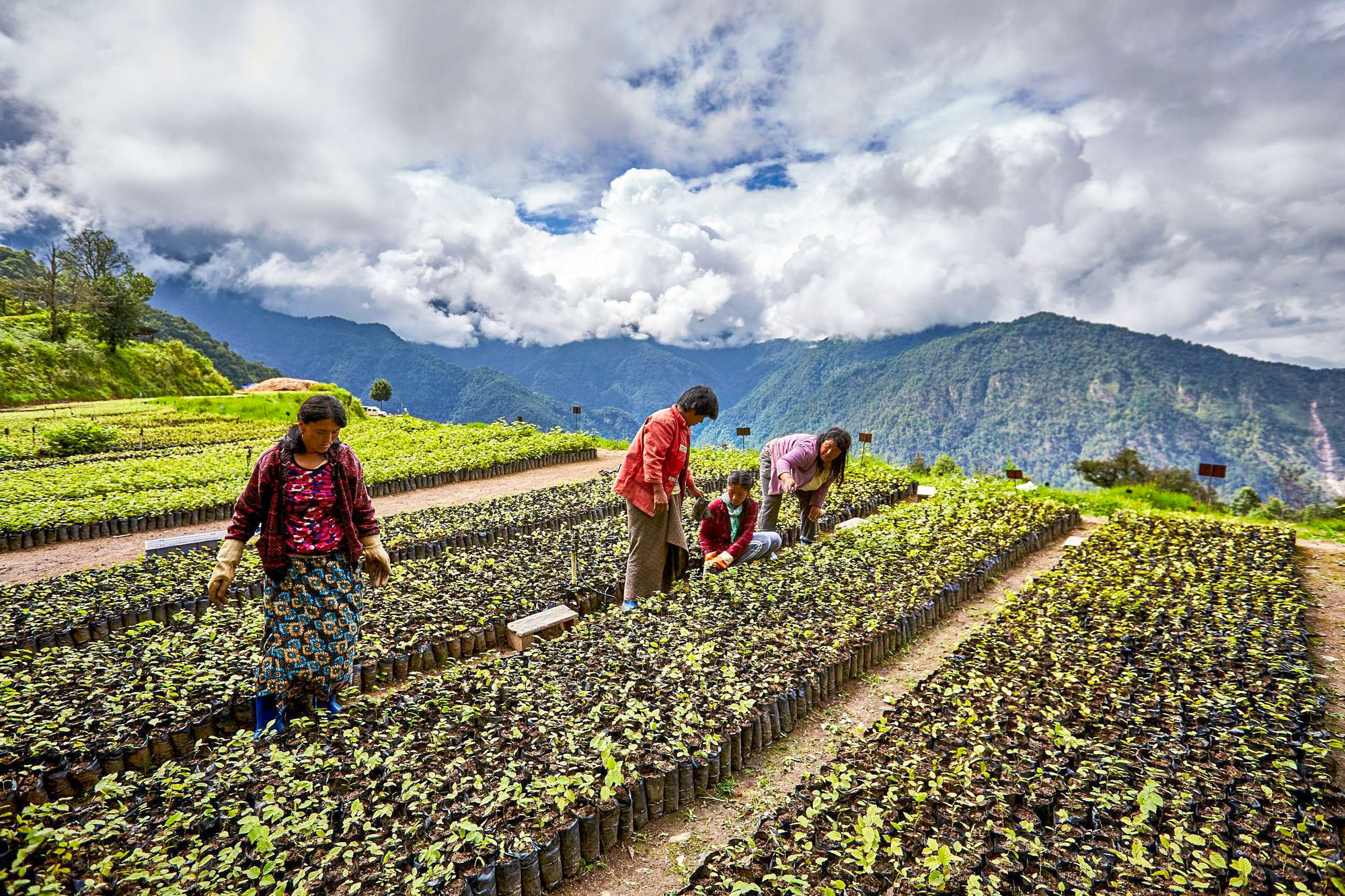
Part VI
People and place
The people the city is built for, how to visit, and the partners who are building it.
Photograph.
16People and community
His Majesty has said that GMC is for Bhutan and for the Bhutanese people. Bhutan has a population of fewer than 800,000, and many young Bhutanese have moved abroad for work in recent years. The city is meant to create conditions in which people can find at home the opportunities they have looked for elsewhere. The masterplan provides for a city of 200,000 residents by 2045.
Land and shared ownership
Because 94 per cent of the land is state land, His Majesty has described it as reserved for Bhutan and shared among the people of all 205 gewogs, the local administrative units of the country. The 2025 National Day address explained that GMC will be structured as a company with shares tied to land holdings, so that landowners keep their stake in the city as it grows.
Land records in the region are administered by the Gelephu Land Office, which works with Bhutan's National Land Commission Secretariat on matters such as the division, realignment and exchange of land parcels.
Zhabto: voluntary service
Volunteer work is one of the most visible features of the project. Zhabto, also written zhabtog, is the Bhutanese practice of offering labour for the common good. More than a thousand volunteers attended the start of airport construction in July 2025. A programme in September 2025 brought 7,050 people to develop parks and public spaces, and more than 10,000 took part in the fourth programme in December 2025. An estimated 40,000 volunteers raised the 108 chortens in November 2026.
The Nation Building Bond
The GMC Nation Building Bond gave citizens a direct financial stake. It was issued in May 2025 by the Gelephu Investment and Development Corporation to fund the airport, with a ten-year term and a coupon of ten per cent a year, and it was open only to Bhutanese citizens resident in Bhutan. The target was Nu. 2 billion. The issue raised Nu. 3.347 billion from 35,403 investors, of whom more than 18,000 were investing for the first time. Bhutanese living in Australia, the United States and Canada have separately pledged close to US$140 million to the airport.
Youth and skills
Pelsung is the flagship youth initiative of the city. It is a three-month programme that combines DeSuung training with innovation projects and time spent working beside experts in GMC. A digital talent platform created by Pelsung participants is used to recruit for the Authority and for companies registered in the region. The Authority holds recruitment drives with licensed firms, and partner companies commit to hiring and training Bhutanese staff.
Related guides: Living and working in GMC · Residency in GMC · Hiring under the Employment Act 2025
17Visiting Gelephu
GMC is open to visitors. The Authority presents it as a gateway to the south of Bhutan, which is warmer and more tropical than the high valleys and lies beside large protected forests. Tourism in the city is planned around slower travel, wellbeing, learning and purposeful gatherings.
Entry requirements
- Visa. A standard Bhutanese tourist visa is valid for GMC, and no additional visa is required.
- Sustainable Development Fee. Bhutan's Sustainable Development Fee applies to visits to GMC, in line with national tourism policy.
- Guide. Tourists travel with a licensed guide under Bhutan's tourism rules.
- Tour operator. Visitors can plan independently, and the Authority recommends accredited Bhutanese tour operators.
- Land border. Entry by the Assam and Bhutan border at Gelephu is open to Indian and Bhutanese nationals.
Getting there
| Route | Operator | Journey | Days |
|---|---|---|---|
| Paro to Gelephu | Drukair | About 25 minutes by air | Monday and Friday |
| Kolkata to Gelephu | Drukair | About 1 hour by air | Monday and Friday |
| Helicopter | Charter | From other parts of Bhutan | On request |
| Road | Private or tour vehicle | From Thimphu and other districts of Bhutan | Daily |
Where to stay
Accommodation in Gelephu is in locally operated hotels. The tourism office names Hotel Kuku Grand, Hotel Dengyam Boutique and Tara Yangstholing among the commonly recommended options.
Things to see and do
- Temples and sacred sites. Serzhong Lhakhang, Sarpang Zangdo Pelri, Tali Dratshang, Pemaling Lhakhang, which is known for astrological readings, the Droduel Phendeyling Chorten at Samtenling, the open-air Buddha at Thubten Choekhorthang and the Shivalaya Hindu Mandir.
- Nature. The Phulari viewpoint, the Dolpani waterfall hike, bird watching for hornbills, kingfishers and eagles, and marked hiking and cycling trails through villages and forest.
- Rivers. Catch-and-release fly fishing for golden mahseer on the Longa River, and the Serzhong suspension bridge.
- Town. Mindfulness in Colour, a series of street murals by six Bhutanese artists in the Old Town, and the cricket stadium.
- From the air. Helicopter tours over the rivers and forests around Gelephu.
Festivals
The main festivals fall in the cooler months. They include the Serzhong Tshechu on 1 November, the Dekiling Tshechu on 19 November, the Janachidue Kurim in the first week of December, the Gelephu Tshechu from 18 to 20 December and the Chuzanggang Tshechu in December.
Suggested itineraries
The tourism office publishes three itineraries. Paths of Peace is a two-day spiritual retreat through sacred sites. Culture in Motion follows Bhutanese heritage and daily life. Southern Edge is an outdoor itinerary built around adventure in the surrounding landscape.
Longer stays
A Digital Nomad Visa programme was launched in January 2026 on a pilot basis with Nomad Club. Successful applicants receive an initial visa of twelve months, renewable for up to twenty-four months, and may live and travel throughout GMC. Other routes to residence, including work passes for employees of GMC companies, are set out in the Employment of Foreign Workforce Act 2025.
Related guides: The Digital Nomad Visa · Immigration and residency guide · What relocating to Gelephu involves
18Immigration, visas and passes
GMC runs its own immigration service. Applications for visas and permits are made through the GMC Immigration System, an online portal operated by the Immigration Office of the Authority in Gelephu. The process is fully online and does not require a visit to an office.
The four passes
| Permit | Who it is for | Application fee | Medical screening |
|---|---|---|---|
| Employment Pass (EP) | Foreign professionals employed by a GMC-registered entity | US$500 | Required |
| Special Pass (SP) | Workers in the skilled and manual categories | US$50 | Required |
| Short-Term Pass (STP) | Visitors staying up to 30 days | US$50 | Not required |
| Dependent Pass (DP) | Dependents of Employment Pass holders | US$500 | Required |
How to apply
- Create an account. An account can be created from outside Bhutan with a valid email address.
- Complete the application. The applicant enters personal and travel details, selects the visa or permit type and uploads supporting documents.
- Pay the fee. Fees are paid in US dollars or the equivalent in ngultrum.
- Submit and track. The status of the application is shown in the applicant's dashboard until a decision is made.
The standard processing time is five to ten working days for a complete application. It can be longer where further information or verification is needed. A visa application is supported by a letter addressed to the Immigration Office, which gives the travel date, the purpose of the visit and the names, document numbers and nationalities of the travellers. The letter is signed by an authorised representative of the GMC-registered entity.
Indian nationals
Indian nationals do not need a visa to enter GMC. Where it applies, they obtain an e-Permit before entry.
Crossing the border by road
Vehicles are registered in advance through the same system. Bhutanese citizens are verified by their citizenship identity number, and foreign nationals give their route from India, their date of entry and their vehicle details. The driver and every passenger are registered for both the outward and the return journey, and the system issues a QR code that is presented at the border gate. Passengers who are not registered are not permitted to cross. Travellers on foot use the immigration terminal described in the transport section.
Other routes
Tourists enter on a standard Bhutanese tourist visa, as set out in the visiting section. Remote workers can apply for the Digital Nomad Visa. Work passes for employees are governed by the Employment of Foreign Workforce Act 2025, and holders of an Employment Pass can serve as the resident director of a GMC company.
Related guides: GMC immigration and residency guide · GMC work passes: the employer's guide · Residency in GMC · Immigration: legal advisory
19International relations and partners
The International Affairs Department is responsible for the region's diplomatic engagement, external affairs and bilateral trade policy, including the negotiation of inter-governmental agreements. The relationships below are the ones that appear most often in the Authority's announcements.
- India
- India is the immediate neighbour and the main market. His Majesty has thanked Prime Minister Narendra Modi and the Government of India for their support for the city. The Authority's first official engagement in India was the Advantage Assam summit in Guwahati in February 2025. In May 2026 it signed a memorandum with the Confederation of Indian Industry, its first with an international business chamber. Indian partners include the Adani Group, Khaitan & Co and Patel Greentech, and His Majesty has appointed a Special Envoy to India for GMC.
- Singapore
- Both Co-Chief Executive Officers previously led Singapore institutions in airports and infrastructure. Bhutan and Singapore signed a double taxation agreement on 12 May 2026, which the Governor described as formal recognition of GMC by Singapore. KK Women's and Children's Hospital advises on the IVF centre, and Changi Airports International is established in the city.
- United Arab Emirates
- The Authority and the financial regulator of Abu Dhabi Global Market signed a memorandum in April 2025, and His Majesty visited the financial centre in May 2025.
- Japan
- Nikken Sekkei leads the design of the first phase of Gelephu Old Town. Joichi Ito, a member of the Board, is president of the Chiba Institute of Technology.
- Denmark
- BIG, the Copenhagen practice behind the masterplan and the airport terminal, opened its South Asia office in GMC.
- Thailand, Bangladesh and others
- Business delegations and media from Thailand have visited, and Bangladesh has discussed jobs and investment connected with the project.
Founding Members
The Founding Member programme is by invitation. Founding Members advise the Board and support projects in the early stages of the city. Ming Z. Mei, co-founder and chief executive of GLP, was the first, and he supports the golf course. Gautam Adani joined in January 2026. Bitdeer Technologies Group is the first Corporate Founding Member.
20Recognition and media coverage
Awards
- Holcim Foundation AwardsNovember 2025
- The masterplan was named a winner of the 2025 Holcim Foundation Awards for sustainable design and construction, which are given across five world regions.
- World Architecture FestivalNovember 2025
- Gelephu International Airport was named Future Project of the Year, the festival's highest honour for an unbuilt project.
- Venice Architecture BiennaleMay to November 2025
- BIG exhibited “Ancient Future” at the nineteenth International Architecture Exhibition. It showed four timber beams engraved with the airport's diamond motif, two of them carved by hand by Bhutanese artisans and two by a robotic arm.
International coverage
The city has been reported by general, business, travel and architecture media since the announcement. Coverage listed by the Authority includes the following.
| Outlet | Subject | Date |
|---|---|---|
| CNN Travel | The design of the new airport and its meaning for the country | March 2025 |
| Time | Bhutan's plan for its economy and the idea of mindful capitalism | May 2025 |
| The B1M | The construction and planning of the city | July 2025 |
| Bangkok Post | A business leaders' visit and the city as a meeting place for the region | July 2025 |
| Tatler | The airport and its planned opening in 2029 | July 2025 |
| The Business Times, Singapore | Mindfulness and nature as drivers of tourism and investment | July 2025 |
| Asia Society Switzerland | Bhutan's path to a mindful future | September 2025 |
| Travel + Leisure | How the city will carry Bhutan into the future | November 2025 |
| The Times of Israel | His Majesty's thinking and what it offers other countries | November 2025 |
| Arup and World Architects | Infrastructure masterplanning and the BIG design | 2025 |
21Leadership
The Board of the Gelephu Mindfulness City Authority is chaired by His Majesty King Jigme Khesar Namgyel Wangchuck. The members and senior officers named by the Authority are listed here.
- Chairman of the BoardHis Majesty King Jigme Khesar Namgyel WangchuckThe Fifth Druk Gyalpo. His Majesty announced the city in 2023, granted the Royal Charter in 2024, chairs the Board of the Authority and guides the development of the region directly.
- GovernorDasho Dr Lotay TsheringFormer Prime Minister of Bhutan. He was appointed Governor in October 2024, leads implementation within Bhutan and reports to the Board.
- Co-Chief Executive OfficerSeow Hiang LeeFounding chief executive of Changi Airport Group for fifteen years, during which Terminal 4 and Jewel Changi Airport were developed. He earlier served as Principal Private Secretary to Minister Mentor Lee Kuan Yew. He studied at Cambridge and at MIT.
- Co-Chief Executive OfficerYee Ean PangInfrastructure investor. He was chief executive of Surbana Jurong Capital and Director General of Investments at the Asian Infrastructure Investment Bank, and he leads work on the science, technology and business parks, public infrastructure and renewable energy.
- Board MemberJoichi “Joi” ItoChief executive of the Gelephu Investment and Development Corporation. He is president of the Chiba Institute of Technology, a co-founder of Digital Garage and a former director of the MIT Media Lab.
- Board MemberDasho Arun KapurEducator with four decades of experience. He founded the Druk Gyalpo's Institute in Paro and led the creation of the Bhutan Baccalaureate, and he previously led Vasant Valley School and The British School in New Delhi.
- Board MemberLauren ChungChief executive of Teneo's strategy and communications business in Asia Pacific and co-chair of the World Economic Forum's Global Future Council on Trade and Investment.
- Board MemberDechen DorjiVice President for Asia in the wildlife conservation programme of WWF-US. As WWF's country representative he launched Bhutan for Life, which raised more than US$43 million for Bhutan's protected areas.
- Board MemberSonam ChodenCivil engineer with a master's degree in water resources management and nearly two decades of work on national housing projects. She is Program Officer at His Majesty's Secretariat and a certified arbitrator.
- Board MemberJigdrel SingayAssociate Director of GreenDigital, a subsidiary of the Gelephu Investment and Development Corporation, and lead for digital assets and fintech. He previously worked at Druk Holding and Investments and sits on the board of the Royal Securities Exchange of Bhutan.
- Board DirectorSiddharth ShahSenior Partner at Khaitan & Co, where he leads the funds practice. He has close to twenty-five years of experience in corporate law, investment funds and regulation, and was appointed in March 2026.
- Gelephu Central BankDavid PetersManaging Director of the Gelephu Central Bank, the institution that carries the central banking mandate conferred in November 2026.
Mun Leong Liew, the founding president of CapitaLand Group, served as the first Chief Executive Officer from October 2024 until November 2025.
Part VII
Reference
Dates, definitions, questions and sources.
Concept image: BIG (Bjarke Ingels Group). Illustrative.
22Timeline
- 2023
- His Majesty announces Gelephu Mindfulness City in the 116th National Day address.
- 2024
- The Royal Charter is granted.
- The first Chief Executive Officer and Board are appointed, the Board meets at Paro Dungkar Dzong, and the concept masterplan is presented.
- Dasho Dr Lotay Tshering is appointed Governor.
- Ming Z. Mei is named the first Founding Member.
- BIG becomes the first international company to register in GMC.
- The 117th National Day address sets out the Diamond Strategy.
- The Application of Laws Act 2024 is announced.
- 2025
- Bitcoin, Ether and BNB are recognised as strategic reserve assets.
- Subscription opens for the GMC Nation Building Bond.
- Eight spiritual projects are granted a Royal Kasho.
- The first Financial Services Licence takes effect.
- Construction of Gelephu International Airport begins.
- The Authority's Thimphu office is inaugurated.
- Three Bhutanese members join the Board.
- A corporate service provider becomes mandatory for new incorporations.
- The masterplan wins a 2025 Holcim Foundation Award.
- Seow Hiang Lee and Yee Ean Pang are appointed Co-Chief Executive Officers.
- DK Bank receives the first banking licence in GMC.
- The first international flight leaves Gelephu for Kolkata.
- The Bitcoin Development Pledge is announced and the TER gold token is launched.
- 2026
- Gautam Adani joins as a Founding Member.
- The Digital Nomad Visa programme is launched.
- The Ugyen Norlha Chorten is consecrated, ground is broken for the Gelephu Chorten, and the plan for 108 chortens is announced.
- Siddharth Shah is appointed to the Board.
- Public consultation closes on six commercial statutes.
- The accelerated licensing pathway is announced.
- Bhutan and Singapore sign a double taxation agreement.
- The Royal Monetary Authority and GFSO sign a memorandum on regulatory cooperation.
- Nikken Sekkei is appointed for the first phase of Gelephu Old Town.
- The framework for family offices and investment funds takes effect.
- The airfield construction contract for the airport is awarded.
- The GMC Immigration Terminal opens with automated e-gates.
- The 108 Jangchub Chortens are raised in one day, and a Royal Decree confers a central banking mandate.
- Ahead
- Showcase projects in Gelephu Old Town; first phase of the workers' dormitory.
- The Hathisar School is expected to open.
- Gelephu International Airport opens.
- Railway connection with India is operational.
- GMC and Bhutan begin to converge.
- One Country, One System.
23Glossary of Bhutanese and official terms
Readers who are new to Bhutan will meet a number of Dzongkha words and official abbreviations in material about the city. The most common are explained here.
- Chorten
- A Buddhist monument, called a stupa in Sanskrit, that holds sacred relics and texts.
- Desuup
- A member of DeSuung, Bhutan's national volunteer service.
- Diamond Strategy
- His Majesty's plan in which GMC and Bhutan follow separate paths from 2025 and converge between 2045 and 2065.
- Druk Gyalpo
- The title of the King of Bhutan. His Majesty King Jigme Khesar Namgyel Wangchuck is the Fifth Druk Gyalpo.
- Dzong
- A fortress that houses both monastic and administrative bodies, found in every district of Bhutan.
- Dzongkhag
- A district of Bhutan. Gelephu is in Sarpang dzongkhag.
- GCRO
- The Gelephu Corporate Registration Office, the registry for companies and other business entities.
- Gewog
- A group of villages that forms the local administrative unit. Bhutan has 205 gewogs.
- GFSO
- The Gelephu Financial Services Office, the financial regulator, which carries the central banking mandate as the Gelephu Central Bank.
- GIDC
- The Gelephu Investment and Development Corporation, the investment arm of the Authority.
- GMCA
- The Gelephu Mindfulness City Authority, the governing body of the region.
- Gross National Happiness
- Bhutan's development philosophy, which measures progress by wellbeing as well as by income.
- Guru Rinpoche
- Padmasambhava, the eighth-century master who brought Vajrayana Buddhism to Bhutan. The name Padmasambhava means “Lotus Born”.
- Gyalsup
- A young person who has completed Gyalsung, Bhutan's national service programme.
- Je Khenpo
- The Chief Abbot of Bhutan and head of the Central Monastic Body.
- Kangyur
- The collected words of the Buddha in 108 volumes.
- Kasho
- A Royal Edict. In GMC it is the formal recognition that makes a spiritual project part of the city.
- Kurim
- A prayer ceremony performed for wellbeing and for the removal of obstacles.
- Lhakhang
- A temple.
- Ngultrum
- The currency of Bhutan, abbreviated Nu. and pegged to the Indian rupee.
- Nye and nyekor
- A nye is a sacred place, and nyekor is the practice of pilgrimage to such places.
- Pelsung
- The youth programme of the city, whose participants are called Pelsups.
- Rabney
- A consecration ceremony.
- Salhang tendrel
- A ground-breaking ceremony.
- SAR
- Special Administrative Region, the legal status of GMC within the Kingdom of Bhutan.
- TER
- The gold-backed digital token issued by the Authority. The word means treasure in Dzongkha.
- Terton
- A revealer of hidden spiritual treasures. Pema Lingpa is the best known in Bhutan.
- Trulku
- A recognised reincarnate lama.
- Tshechu
- An annual religious festival with masked dances, held in each district.
- Zhabto
- Voluntary labour offered for the common good, also written zhabtog.
- Zhung Dratshang
- The Central Monastic Body of Bhutan.
- Zung
- The sacred relics and texts sealed inside a chorten or statue.
Legal terms are explained in the GMC Legal Glossary.
24Frequently asked questions
The answers below are drawn from material published by the Gelephu Mindfulness City Authority and from the Acts of GMC. Each one gives the date or figure that the source gives.
The basics
What is Gelephu Mindfulness City?
Gelephu Mindfulness City, or GMC, is a Special Administrative Region in southern Bhutan. It was established by Royal Charter No. 1 of 2024, granted by His Majesty King Jigme Khesar Namgyel Wangchuck on 10 February 2024. It has its own executive and legislative powers and an independent judiciary, and it is being developed as a city that joins economic growth with spirituality and care for nature.
Where is Gelephu Mindfulness City?
It is on Bhutan's southern plains, around the town of Gelephu in Sarpang district, on the border with the Indian state of Assam. The land border crossing at Gelephu meets the Dadgari crossing on the Indian side.
How big is GMC?
The region covers about one million acres, or roughly 4,000 square kilometres, which is close to ten per cent of Bhutan. The masterplan covers more than 2,500 square kilometres of that area. According to the 2025 National Day address, 94 per cent of the land is state land.
What does GMC stand for?
GMC stands for Gelephu Mindfulness City. The governing body is the Gelephu Mindfulness City Authority, shortened to GMCA. The financial regulator is the Gelephu Financial Services Office, or GFSO, and the company registry is the Gelephu Corporate Registration Office, or GCRO.
When was GMC established?
His Majesty announced the city on 17 December 2023, in the 116th National Day address. The Royal Charter was granted on 10 February 2024. The first Chief Executive Officer and Board were appointed on 1 October 2024, the Governor on 4 October 2024, and the first law, the Application of Laws Act 2024, was announced on 26 December 2024.
Who founded Gelephu Mindfulness City, and who runs it?
The city is the vision of His Majesty King Jigme Khesar Namgyel Wangchuck, who chairs the Board of the Gelephu Mindfulness City Authority. The Governor is Dasho Dr Lotay Tshering, a former Prime Minister of Bhutan. The Co-Chief Executive Officers, appointed on 5 November 2025, are Seow Hiang Lee and Yee Ean Pang.
Why is it called a Mindfulness City?
The name reflects the idea of Mindful Prosperity, in which economic development is pursued together with Bhutanese values of spirituality, harmony with nature and community. In the 2025 National Day address His Majesty also described GMC as the first Buddhist city, and twenty-two sacred sites have been approved alongside the commercial and public infrastructure.
Is GMC a separate country?
GMC is part of the Kingdom of Bhutan. It is a Special Administrative Region with its own laws, administration and courts, under a framework described as One Country, Two Systems.
What is the Diamond Strategy?
The Diamond Strategy is His Majesty's long-term plan for GMC and Bhutan, set out in the National Day address of 17 December 2024. From 2025 the two follow separate paths for about two decades. From 2045 they begin to converge, with the aim of forming one advanced economy under One Country, One System by 2065.
What is Mindful Prosperity?
Mindful Prosperity is the philosophy behind the city. It holds that development should continue because prosperity matters, and that it should be carried out in balance with nature and with spiritual life. The roadmap built on it names eight priority sectors.
How is GMC different from a special economic zone?
A special economic zone usually applies a different tax or customs regime inside a country's existing legal system. GMC has its own body of law, its own regulators and registry, its own courts and its own governing Authority, with executive and legislative powers conferred by Royal Charter.
How many people will live in GMC?
The plan for the period from 2030 to 2045 is a city that supports 200,000 residents, with clusters established in all eight priority sectors.
Government and law
Which laws apply in GMC?
GMC has its own statutes, which follow common law principles. They are the Application of Laws Act 2024, the Companies Act 2025, the Customs Act 2025, the Employment Act 2025, the Employment of Foreign Workforce Act 2025, the Financial Services Act 2025, the Income Tax Act 2025, and six commercial statutes of 2026 on business names, limited liability partnerships, limited partnerships, partnerships, the sale of goods and unfair contract terms. The GMC Law Library lists them in full.
Does GMC have its own courts?
Yes. The Royal Charter provides for an independent judiciary, and the legal framework provides for international commercial arbitration. An International Dispute Resolution Centre is part of the institutional plan for the region.
What legal system does GMC use?
GMC uses a common law system. Its statutes are written for commercial use, and its courts can rely on precedents from established common law jurisdictions.
What is the Gelephu Mindfulness City Authority?
The Authority, known as GMCA, is the governing body of the region. Its Board is chaired by His Majesty the King. It includes the Governor's Office, City Development, the Economic Development Group, International Affairs, the Gelephu Corporate Registration Office and the financial regulator.
Who sits on the Board?
The Board is chaired by His Majesty. Its members are Seow Hiang Lee and Yee Ean Pang, who are the Co-Chief Executive Officers, together with Joichi Ito, Dasho Arun Kapur, Lauren Chung, Dechen Dorji, Sonam Choden, Jigdrel Singay and Siddharth Shah.
Does the public get a say in new GMC laws?
The Authority has consulted the public on draft legislation. A consultation on six draft commercial statutes ran for two weeks and closed on 20 April 2026, with comments invited section by section.
Does GMC have data protection law?
Yes. GMC has its own data protection law, which applies to the processing of personal information, including sensitive health data.
How does GMC relate to Bhutan's national authorities?
GMC is governed separately from the Royal Government of Bhutan, and the two coordinate. The Royal Monetary Authority of Bhutan and GFSO signed a memorandum on regulatory cooperation on 20 June 2026, GMC is represented on Bhutan's national committees for anti-money laundering policy, and the tax agreement with Singapore was signed on behalf of both the Royal Government and GMC.
Business and companies
What are the eight priority sectors?
They are spirituality, health and wellness, education and knowledge, agri-tech and forestry, green energy and technologies, finance and digital assets, aviation and logistics, and tourism. Tourism was added as the eighth sector during 2025.
Can a foreign company set up in GMC?
Yes. Companies are incorporated through the Gelephu Corporate Registration Office under the Companies Act 2025. The Economic Development Group supports investors with land identification, lease guidance, incorporation, regulatory clearances, visas and aftercare. The GMC company formation guide explains the process.
What kinds of business entity can be formed?
Seven kinds are registered by the Gelephu Corporate Registration Office: the private company limited by shares, the public company limited by guarantee, the branch of a company, the limited liability partnership, the limited partnership, the general partnership and the sole proprietorship.
How do I register a company in GMC?
The process starts with a free expression of interest to the Gelephu Corporate Registration Office. After the office approves the proposal, the applicant appoints an empanelled corporate service provider, files the incorporation form, pays the fee online and receives a digital certificate of incorporation with a unique entity number. The whole process is online.
How long does incorporation take?
The Gelephu Corporate Registration Office estimates about one week from receipt of a complete set of documents.
What does it cost to register a company?
The registration fee is US$2,000 for a private company limited by shares and for a branch, US$500 for a public company limited by guarantee and US$250 for a sole proprietorship. Registration is renewed each year on the anniversary of incorporation. A special unique entity number costs a one-time US$3,000.
What is the minimum capital for a GMC company?
The minimum paid-up capital is US$1. Higher minimums apply to particular activities, such as regulated financial services, and to eligibility for certain tax incentives.
Does a GMC company need a resident director?
Yes. Every company has at least one director who is ordinarily resident in GMC. The role can be held by an employee with a valid Employment Pass or by a Bhutanese citizen. A branch appoints a resident authorised representative.
Which officers must a company have?
A company has at least one director, one shareholder, one secretary and one auditor, and it designates at least one data protection officer under the GMC Personal Data Protection Act. The post of secretary may not stay vacant for more than six months.
Is a corporate service provider required?
Yes. Since 1 November 2025 a corporate service provider is required for every new incorporation, except for sole proprietorships owned by Bhutanese citizens. Four firms are fully empanelled by the Authority for the period from 1 November 2025 to 1 October 2027.
Which words cannot be used in a company name?
Restricted terms include Bhutan, BTN, BT, Druk, Group of Companies, Partnership, domain extensions, GMC, GMCA, Gelephu Mindfulness City, and words such as Royal, Government or Department that need prior approval.
Which international companies are in GMC?
The architecture practice BIG was the first international company to register, in December 2024. Others that have registered, been licensed or announced operations include Matrixport, Ceffu, BTSE, Bitget, Nansen, Bitdeer, Changi Airports International, Khaitan & Co and Waive Diagnostics.
How many companies have applied to set up?
In the National Day address of 17 December 2025, His Majesty said that more than fifty applications had been received from international companies, and that seventy buildings in the existing town were being renovated for use as offices.
What is a Founding Member?
Founding Members are invited individually and act as advisers to the Board. Ming Z. Mei, co-founder and chief executive of GLP, was named the first on 12 December 2024. Gautam Adani joined on 3 January 2026, and Bitdeer Technologies Group is the first Corporate Founding Member.
What support do investors receive?
The Authority describes a one-stop service that covers the identification of land plots, guidance on leases, company incorporation, regulatory clearances, coordination with government agencies, visa and employment matters and investor aftercare. It offers flexible long-term leases.
Is there a workforce available?
Bhutan has a young, English-speaking workforce. The Authority holds recruitment drives, runs the Pelsung youth programme and a digital talent platform, and licensed firms commit to hiring and training Bhutanese staff. Foreign staff work under the Employment of Foreign Workforce Act 2025.
Finance and digital assets
Who regulates financial services in GMC?
The Gelephu Financial Services Office regulates banking, capital markets, payments, insurance, funds and digital assets carried on in or from GMC. A Royal Decree signed on 1 November 2026 confers a central banking mandate, and the office becomes the Gelephu Central Bank, with licensing and supervision continuing in its Financial Supervision division.
What can the Gelephu Central Bank do?
Under its mandate it conducts monetary policy, manages foreign reserves, oversees financial stability, supervises financial institutions, provides liquidity support, establishes payment and settlement systems, issues central bank securities and develops money and capital markets. It can hold digital assets as reserves, and the Charter provides a pathway to a GMC currency with His Majesty's concurrence.
How long does a financial services licence take?
GFSO states that successful applicants receive In-Principle Approval within six to eight months of submission on average. Firms already licensed in Singapore, Abu Dhabi Global Market or Hong Kong can use an accelerated pathway, and fund managers licensed in a recognised jurisdiction can use a no-objection process with a four-week response time.
How much does a licence cost?
The application fee and the annual supervision fee are each US$5,000 for most regulated activities. They are US$35,000 for accepting deposits, US$15,000 to US$25,000 for insurance business, and US$50,000 for operating a trading facility. Fees are charged per regulated activity.
What capital does a licensed firm need?
Base capital depends on the activity. It is US$10 million for accepting deposits, US$2 million for providing credit, for dealing as principal and for issuing a fiat-referenced token, US$200,000 or six months of operating expenses for custody, money services and asset management, and US$10,000 or six months of operating expenses for advising and arranging.
How many financial institutions are licensed?
The public register listed fourteen active institutions on 12 November 2026. The first licence took effect on 3 July 2025. The list includes DK Pte Ltd, which is the bank, a multilateral trading facility, custodians, payment firms, an insurance broker, an insurer and the issuer of a fiat-referenced token.
Which bank serves GMC companies?
DK Bank is the official bank of GMC and, on 28 November 2025, became the first bank licensed there. It offers accounts in nine currencies: US dollars, pounds sterling, euros, Australian dollars, yen, Singapore dollars, Indian rupees, Hong Kong dollars and ngultrum. Companies that obtain a licence are guaranteed a corporate account.
Is cryptocurrency legal in GMC?
Yes. Virtual asset activity is regulated under the Financial Services Act 2025, and firms need a Financial Services Licence. Bitcoin, Ether, BNB, USDC and USDT are generally treated as accepted virtual assets. Bitcoin, Ether and BNB have also been recognised as strategic reserve assets since 8 January 2025.
Can stablecoins be issued in GMC?
Yes. Issuing a stablecoin falls under the regulated activity of issuing a fiat-referenced token, which carries a base capital requirement of US$2 million. A licence for this activity took effect on 12 November 2026.
What is the Bitcoin Development Pledge?
It is a commitment announced on 17 December 2025 to dedicate up to 10,000 Bitcoin from Bhutan's national holdings, valued at about US$1 billion at the time, to the long-term development of GMC. Its aims are work and skills for Bhutanese youth and stronger national financial resilience.
What is TER?
TER is a digital token backed by physical gold. One token represents 0.01 gram of gold of .9999 purity. It is issued by the Gelephu Mindfulness City Authority on the Solana blockchain and distributed by DK Bank, which holds the gold in custody. It launched on 17 December 2025, and reserves are audited each quarter.
Can a family office be set up in GMC?
Yes, under a framework that took effect on 1 October 2026. A family office that holds at least US$10 million in assets notifies GFSO and receives a tax exemption on income from designated investments for up to fifteen years, without a licence. The threshold is US$50 million for vehicles investing in areas such as real estate, energy or infrastructure.
Tax
What taxes apply in GMC?
GMC has its own tax system under the Income Tax Act 2025. It is territorial, it has no capital gains tax, dividend tax or inheritance tax, and it offers incentives for qualifying companies, family offices and funds. The GMC Tax Guide sets out the rates.
What is the corporate tax rate in GMC?
The corporate income tax rate is 15 per cent. Withholding tax is 0 per cent on dividends, 10 per cent on interest and 5 per cent on royalties. These figures are from the Authority's published summary of the tax regime.
How are individuals taxed in GMC?
GMC tax residents who are citizens of Bhutan pay progressive rates from 5 to 15 per cent on chargeable income above US$10,000. Global talent accompanying foreign investment is exempt until 31 December 2030. Personal reliefs include earned income relief of up to US$1,500, a spouse deduction of US$1,500 and US$500 for each child.
Does Bhutan's GST apply in GMC?
No. Bhutan introduced a goods and services tax of five per cent on 1 January 2026. It does not apply in GMC, which continues with its existing sales tax system.
Are there tax incentives for companies?
Yes. Qualifying companies in priority sectors can receive incentives that include a zero per cent corporate rate, depending on the level of investment. Firms that show economic substance in GMC, including the hiring of Bhutanese citizens, can apply for incentives.
What tax do fund managers pay?
Fund managers pay five per cent if they manage US$25 million or more and ten per cent if they manage less, for up to twenty years. Managers approved before the end of 2027 pay no tax for the first five years, and carried interest is exempt.
Is there a tax treaty that covers GMC?
Bhutan and Singapore signed an agreement for the avoidance of double taxation on 12 May 2026. It was signed by Bhutan's Finance Minister on behalf of both the Royal Government and GMC, and it provides for the exchange of information and measures against treaty abuse.
How are customs declarations made?
Import and export declarations are made online through the GMC Electronic Customs Management System, which also handles registration, payment and the tracking of applications.
The city and its infrastructure
Who designed the masterplan?
The masterplan was designed by BIG, the Bjarke Ingels Group, with Arup and Cistri. It was presented in Paro on 1 October 2024 and was named a winner of the 2025 Holcim Foundation Awards. The first phase of Gelephu Old Town is being designed by Nikken Sekkei of Japan.
When will Gelephu International Airport open?
The opening is planned for December 2029, with inauguration on 17 December 2029, Bhutan's National Day. Construction began on 8 July 2025, and the airfield contract was awarded to Rigsar-Vajra Joint Venture on 3 October 2026.
How large is the new airport?
The site covers about four square kilometres across the Paitha River. The runway is 3,000 metres long, with an Instrument Landing System. Capacity is 1.3 million passengers a year at opening, expandable to 5.5 million and beyond.
What are the phases of development?
Phase 0 covered 2025 and established the laws and frameworks. Phase 1 runs to 2030, with Gelephu Old Town revitalised by 2027 and the airport and rail link operational by 2030. Phases 2 and 3 run from 2030 to 2045 and build a city for 200,000 residents. Phase 4 begins in 2045.
What is happening in Gelephu Old Town?
About forty buildings covering 36,000 square metres are being rebuilt as a connected urban centre with a Bhutanese identity. The first phase is expected to be complete by the end of 2028.
Will there be a railway?
A railway connection with India is planned to be operational by 2030, under Phase 1B of the development plan.
What is the Green Technology Valley?
It is the Authority's plan for an area where renewable energy, digital infrastructure, research and talent are located together. The target is more than three gigawatts of data centre capacity by 2035. Letters of intent for AI data centre campuses were signed with SATO Technologies in July 2026 and with Bitdeer in October 2026.
Is there a school in GMC?
The Hathisar School, a primary school offering the Bhutan Baccalaureate from early childhood to grade six, is expected to open in February 2028 under a memorandum signed in November 2026.
Sacred sites
How many sacred sites are there?
Twenty-two sacred sites have been approved by Royal Kasho. The first fourteen were approved during 2025, and eight more were approved in 2026.
What is the Gelephu Chorten?
It is an 80-metre stupa modelled on the Jarung Khashor stupa in Kathmandu, also known as Boudhanath. His Majesty commanded its construction in 2023, and ground was broken on 21 February 2026 in the presence of three generations of the Royal Family and more than 12,000 volunteers.
What are the 108 chortens?
They are 108 Jangchub Chortens, or stupas of enlightenment, each fifteen metres tall, raised in a single day on 1 November 2026. They stand in single file along the Mao River, 108 metres apart, over about twelve kilometres. An estimated 40,000 volunteers took part.
What is a Royal Kasho?
A Kasho is a Royal Edict issued by His Majesty. In GMC it is the formal recognition that makes a spiritual project part of the city. Only projects with a Kasho are officially endorsed.
What is the Lotus-Born Trail?
It is a pilgrimage trail that follows the route Guru Rinpoche is said to have taken in the eighth century from the plains near Gelephu through Trongsa to Bumthang. Construction began in December 2025.
Are other religions represented?
Yes. The Shivalaya Yagyaswar Mahadev Mandir, a Hindu temple given by His Majesty in 2018, is being gilded as the Golden Mandir. The city is described as open to several Buddhist schools and to other wisdom traditions.
Immigration and passes
How do I apply for a GMC visa or permit?
Applications are made online through the GMC Immigration System. The applicant creates an account, completes the application, uploads documents, pays the fee and tracks the result in a dashboard. An account can be created from outside Bhutan.
What types of permit does GMC issue?
GMC Immigration issues four permits. The Employment Pass is for foreign professionals employed by a GMC-registered entity. The Special Pass is for skilled and manual workers. The Short-Term Pass is for visitors staying up to 30 days. The Dependent Pass is for dependents of Employment Pass holders.
How much do GMC permits cost?
The application fee is US$500 for an Employment Pass, US$50 for a Special Pass, US$50 for a Short-Term Pass and US$500 for a Dependent Pass. Fees are paid in US dollars or the equivalent in ngultrum.
How long does a permit application take?
The standard processing time is five to ten working days for a complete application. It can be longer where further information, documents or verification are needed.
Is a medical screening required?
Medical screening is required for the Employment Pass, the Special Pass and the Dependent Pass.
Do Indian nationals need a visa for GMC?
No. Indian nationals do not need a visa to enter GMC. Where it applies, they obtain an e-Permit before entry.
What goes in the visa application letter?
The letter is addressed to the Immigration Office of the Authority. It states the intended travel date, the purpose of the visit in detail and the number of travellers with their names, passport or identity document numbers and nationalities. It is signed by an authorised representative of the GMC-registered entity.
How do vehicles cross the border into GMC?
Vehicles are registered in advance through the GMC Immigration System, with the driver and every passenger listed for both directions of travel. The system issues a QR code that is presented at the border gate.
Visiting and living
Can tourists visit GMC now?
Yes. The city is being developed in phases, and visitors can already explore Gelephu and the surrounding area, including festivals, nature trails, temples and community activities.
Do I need a special visa for GMC?
No. A standard Bhutanese tourist visa is valid for GMC, and no additional visa is required.
Does the Sustainable Development Fee apply?
Yes. Bhutan's Sustainable Development Fee applies to visits to GMC, in line with national tourism policy.
Do I need a guide?
Yes. Tourists travel with a licensed guide under Bhutan's tourism rules. Visitors can plan independently, and the Authority recommends accredited Bhutanese tour operators.
How do I get to Gelephu?
Drukair flies between Paro and Gelephu, a flight of about 25 minutes, and between Kolkata and Gelephu, a flight of about one hour. Both operate on Mondays and Fridays. Gelephu can also be reached by road from other parts of Bhutan, and helicopter services are available.
Can foreigners enter by land from India?
Entry by the land border at Gelephu is open to Indian and Bhutanese nationals. The GMC Immigration Terminal, which opened on 22 October 2026, has automated e-gates for them. Facilities for nationals of other countries are being introduced in coordination with the Government of India.
What is there to see?
Sights include Serzhong Lhakhang, Sarpang Zangdo Pelri, Tali Dratshang, Pemaling Lhakhang, the Shivalaya Hindu Mandir, the Phulari viewpoint, the Dolpani waterfall, the Serzhong suspension bridge and the street murals of the Old Town. Activities include hiking, cycling, bird watching and catch-and-release fly fishing for golden mahseer.
When are the festivals?
The Serzhong Tshechu is on 1 November, the Dekiling Tshechu on 19 November, the Janachidue Kurim from 1 to 8 December and the Gelephu Tshechu from 18 to 20 December. The Chuzanggang Tshechu is also held in December.
Is there a visa for remote workers?
Yes. A Digital Nomad Visa programme was launched in January 2026 on a pilot basis. The initial visa runs for twelve months and can be renewed for up to twenty-four months, and holders may live and travel throughout GMC.
Who owns the land in GMC?
According to the 2025 National Day address, 94 per cent of the land is state land, and much of the private land belongs to rural families. His Majesty has explained that GMC will be structured as a company with shares tied to land holdings, so that landowners keep a stake.
How can Bhutanese citizens take part?
Citizens have taken part through volunteer programmes, through the GMC Nation Building Bond, which raised Nu. 3.347 billion from 35,403 investors in 2025, through the Pelsung youth programme and through recruitment drives held by the Authority and licensed firms.
More questions are answered in GMC Legal FAQs.
26Sources and method
This page is compiled from public material issued by the Gelephu Mindfulness City Authority and its offices, including its published statements, frequently asked questions, legislation list, tourism information and news releases from October 2024 to November 2026. It also draws on the Royal Charter and the Acts of GMC, the published guidance and register of the Gelephu Financial Services Office, and His Majesty's National Day addresses of 2023, 2024 and 2025.
Where official material gives more than one figure for the same subject, the page uses the figure that appears most consistently. The area of the region is given as about one million acres or roughly 4,000 square kilometres, and the establishment of the region is dated from the Royal Charter of 10 February 2024. Images marked as illustrative are concept images and are included to show the intended character of the city.
Image credits
Masterplan and airport concept images are by BIG (Bjarke Ingels Group), the designer of the Gelephu Mindfulness City masterplan and of Gelephu International Airport. The photograph of the foothills seen from Gelephu is by MoutainBoy and the photograph of the Manas River is by Kheng Singye Dorji, both from Wikimedia Commons under the Creative Commons Attribution-ShareAlike 4.0 licence. Other images are illustrative concept images. Diagrams are by Basnet Law Pte. Ltd.
Basnet Law Pte. Ltd. is a law firm incorporated in Gelephu Mindfulness City. This page is general information. It is reviewed when the Authority publishes new material, and the date of the last review appears at the top.
You may contact Basnet Law at basnet@basnetgmc.com or office@basnetgmc.com for any legal queries related to GMC.


