Among the special administrative regions (SARs) and special economic zones (SEZs) of the world, Bhutan's Gelephu Mindfulness City (GMC) is a distinctly different model. This article sets out what separates GMC from other special administrative regions: its philosophical foundations, its governance and legal structure, its economic approach and its environmental commitments, as they stand in 2026. Understanding these features helps investors, policymakers and citizens judge GMC's significance as a blueprint for 21st-century urban development.
Beyond Economic Growth: A Philosophical Revolution
The Mindfulness Foundation
The most fundamental distinction between GMC and other special administrative regions lies in its philosophical foundation. While most SARs and SEZs are established primarily to accelerate economic growth through regulatory relaxation and tax incentives, GMC begins with a different premise: that urban development should serve holistic human flourishing rather than narrowly defined economic metrics.
"It will be one-of-a-kind, anchored on the vision and values of GNH. It will be a Mindfulness City, encompassing conscious and sustainable businesses, inspired by Buddhist spiritual heritage, and distinguished by the uniqueness of the Bhutanese identity," declared His Majesty King Jigme Khesar Namgyel Wangchuck when announcing the project.
This mindfulness-centered approach represents an evolution of Bhutan's pioneering Gross National Happiness (GNH) philosophy, which has guided the country's development since the 1970s. Prime Minister Tshering Tobgay describes GMC as "gross national happiness 2.0," explaining, "We've applied GNH throughout the country. The approach has produced results. But how do we apply GNH in a modern urban environment?"
Comparative Context: Conventional SARs
To appreciate this distinction, consider the founding principles of other prominent special administrative regions:
- Hong Kong SAR (China): Established to maintain Hong Kong's capitalist system and way of life while returning sovereignty to China, with economic prosperity and stability as primary goals.
- Dubai International Financial Centre (UAE): Created specifically to establish a global financial hub with regulatory independence, focusing almost exclusively on economic and financial sector development.
- Shenzhen SEZ (China): Developed as an experiment in market-oriented reforms and opening to foreign investment, with GDP growth as the central metric of success.
- Iskandar Malaysia: Designed primarily to capitalize on proximity to Singapore and attract spillover investment through competitive cost structures.
While these regions have achieved remarkable economic success by conventional measures, none began with an explicit philosophical commitment to balancing material prosperity with spiritual well-being, environmental sustainability, and cultural integrity. GMC's mindfulness foundation represents a fundamental reimagining of what urban development can and should prioritize.
Selective Investment Approach: Quality Over Quantity
Curated Business Ecosystem
A second major distinction is GMC's selective approach to investment. Unlike conventional SARs that typically welcome any business willing to invest, GMC screens applicants against its eight priority industries: every expression of interest submitted to the Gelephu Corporate Registration Office (GCRO) is assessed against them before incorporation can proceed.
As reported in The Diplomat, "Gelephu, unlike other SEZs, will host businesses screened and invited based on their respect for the Bhutanese way of life, sustainable and equitable development, and sovereignty." This curated approach prioritizes the quality and alignment of investment over sheer quantity or size.
Comparative Context: Open-Door Policies
This selective stance contrasts sharply with the approach of most special economic zones:
- Shenzhen SEZ: Initially welcomed virtually any manufacturing operation willing to establish facilities, with limited environmental or social screening.
- Dubai Multi Commodities Centre: Offers fast-track licensing to almost any business that meets basic financial requirements, with minimal values-based screening.
- Panama Pacifico Special Economic Area: Focuses primarily on tax benefits and streamlined processes to attract the maximum number of companies across sectors.
GMC's selective approach creates a more coherent, values-aligned business ecosystem that supports its broader vision of mindful development.
Governance Integration: Autonomy with Cultural Continuity
Bhutanese Values in Modern Governance
GMC's governance model is another significant innovation. While operating as an autonomous region with executive, legislative and independent judicial authority under Royal Charter No. 1 of 2024, GMC maintains deep integration with Bhutanese cultural values and leadership structures.
This is evident in its constitutional design. The Gelephu Mindfulness City Authority (GMCA), the highest decision-making body under Article 3 of the Charter, is chaired by the Druk Gyalpo, every GMC Act is made with Royal Assent, security is provided by the Armed Forces of Bhutan and the Charter can be amended only by Royal Decree. This structure creates a bridge between traditional Bhutanese governance and modern administrative requirements.
The Application of Laws Act 2024 (GMC Law No. 1 of 2024), in operation from 26 December 2024, demonstrates this balanced approach. It applied the common law and equity of established common law jurisdictions, a schedule of applied statutes and a schedule of financial services rulebooks drawn from an established international financial centre, and GMC has since enacted its own Companies Act 2025, Financial Services Act 2025, Income Tax Act 2025 and nine further Acts, sixteen instruments in all, each made with Royal Assent. Basnet Law Pte. Ltd. was the first law firm incorporated under the Companies Act 2025.
Comparative Context: Governance Disconnects
This integrated approach differs notably from governance models in other special regions:
- Hong Kong SAR: Operates under the "One Country, Two Systems" principle, creating an intentional separation between Hong Kong's governance system and mainland China's approach.
- Labuan International Business and Financial Centre (Malaysia): Functions almost as a separate jurisdiction with minimal integration of Malaysian cultural elements in its governance approach.
- Batam Free Trade Zone (Indonesia): Operates under special regulations that often create disconnects with Indonesian cultural and governance traditions.
GMC's model suggests that administrative autonomy need not require cultural disconnection, that special regions can maintain distinctive regulatory approaches while remaining authentically connected to national identity and values.
Environmental Integration: Building With Nature
Nature-First Urban Design
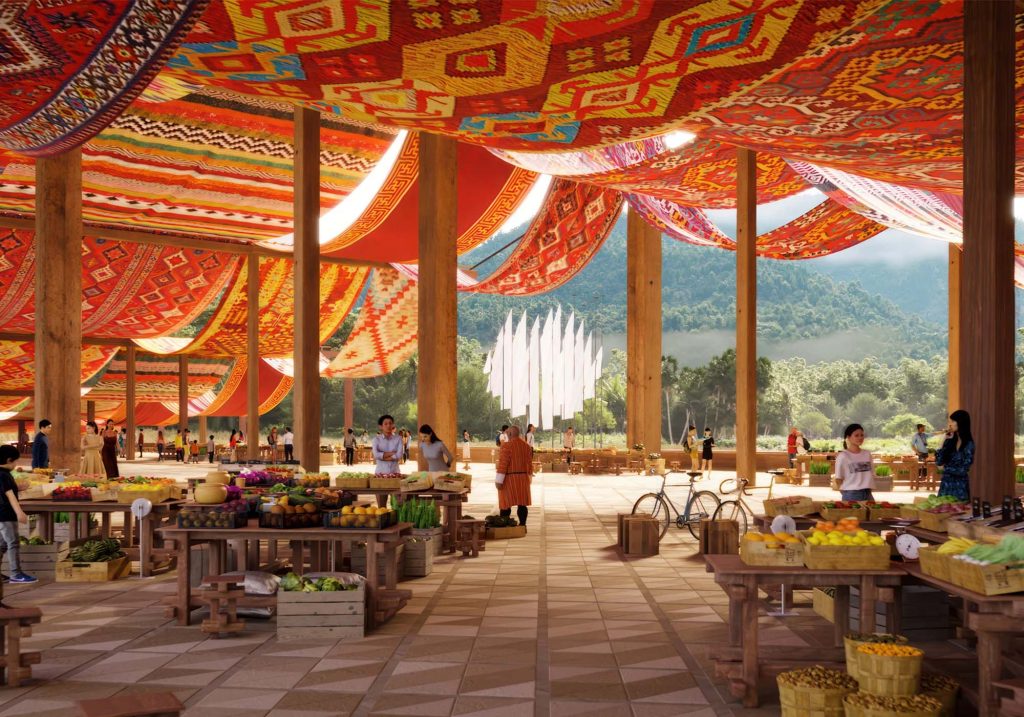
Perhaps the most visually striking distinction between GMC and other special administrative regions lies in its physical design and environmental approach. Masterplanned by Bjarke Ingels Group with Arup, Cistri and MQDC as eleven mandala-inspired neighbourhoods, GMC's design embeds the city within nature rather than replacing it.
Key features include:
- No structure taller than the surrounding trees
- Minimal development near wildlife sanctuaries and farmlands
- Dzong (fortress)-inspired inhabitable bridges containing key infrastructure
- A Temple-Dam on the Sankosh River that integrates spiritual architecture with renewable energy generation
This "Building with Nature" philosophy extends to operating commitments announced with the masterplan: electric vehicles, no single-use plastics, organically sourced food and renewable electricity. The city aims to be a carbon-negative urban development, extending Bhutan's national achievement to the city scale.
Comparative Context: Nature as Afterthought
This approach contrasts dramatically with conventional urban development in special economic zones:
- Shenzhen SEZ: Rapid development led to extensive environmental degradation, with environmental considerations addressed primarily as remediation after economic growth.
- Iskandar Malaysia: Despite sustainability rhetoric, development has proceeded with conventional urban forms that often require substantial modification of natural systems.
- Clark Special Economic Zone (Philippines): Developed primarily through conversion of a former military base, with nature treated as amenity rather than foundational element.
While many newer special zones now incorporate sustainability elements, GMC stands apart in making environmental integration the starting point of design rather than a modification to conventional urban forms.
Digital Asset Innovation: Blockchain at the Core
Strategic Digital Reserves
Bhutan's Bitcoin Development Pledge, announced on 17 December 2025, allocated up to 10,000 BTC from national reserves to support GMC's development, structured as a long-term sovereign reserve intended to generate yield without selling the assets. In July 2026 the digital asset investment manager 3iQ Corp announced a partnership to manage a mandate backed by a portion of those reserves. This makes GMC one of the few jurisdictions whose development is backed by a sovereign digital asset reserve.
The approach extends to the city's financial infrastructure. DK Bank, the first GMC-licensed bank, offers corporate accounts in nine currencies and digital asset services, and provided custody when the gold-backed token TER launched on Solana in December 2025 under a sovereign framework. Under the Financial Services Act 2025 the Gelephu Financial Services Office (GFSO) regulates virtual assets and fiat-referenced tokens under the same statute as banking, capital markets, payments and insurance; Matrixport received a financial services licence in September 2025 and BTSE Bhutan in-principle approval in May 2026. Rather than merely permitting cryptocurrency operations within its borders, GMC integrates digital assets into its economic architecture.
Comparative Context: Cautious Regulation
This proactive stance differs markedly from approaches in other regions:
- Hong Kong SAR: Has moved toward regulated cryptocurrency trading but maintains a cautious approach to institutional integration of digital assets.
- Dubai International Financial Centre: Permits regulated cryptocurrency operations but has not integrated digital assets into government reserves or central banking.
- Singapore: Despite being a financial innovation hub, maintains clear separation between conventional monetary policy and digital asset ecosystems.
GMC's approach reflects a different relationship with financial innovation, one that treats digital assets as core components of economic infrastructure rather than peripheral experiments, while keeping them inside the regulatory perimeter.
Cultural Authenticity: Development Without Westernization
Bhutanese Identity at the Center
A subtle but profound distinction lies in GMC's commitment to maintaining authentic Bhutanese cultural identity throughout its development. Unlike many special economic zones that effectively become culturally internationalized spaces with limited connection to local traditions, GMC explicitly centers Bhutanese identity in its design, governance, and economic focus.
This is evident in the prominence given to the Vajrayana center as an initial development priority, the integration of traditional architectural elements throughout the masterplan, and the commitment to screening businesses based partly on their respect for Bhutanese cultural values.
Comparative Context: Cultural Dilution
This approach contrasts with the cultural evolution of many special economic zones:
- Shenzhen SEZ: Rapidly transformed from a fishing village to a cosmopolitan city with limited preservation of local cultural distinctiveness.
- Dubai International Financial Centre: Functions as an international enclave with governance and culture substantially disconnected from traditional Emirati practices.
- Incheon Free Economic Zone (South Korea): Deliberately adopts international standards and practices that often diverge from traditional Korean approaches.
GMC's emphasis on cultural authenticity suggests that economic development need not require cultural homogenization, that distinctive cultural identities can be preserved and even strengthened through thoughtful development approaches.
Eight Priority Industries: Beyond Industrial Specialization
Holistic Economic Ecosystem
GMC's organisation around eight interconnected priority industries is another distinctive approach. Rather than focusing narrowly on manufacturing, financial services or technology as many special zones do, GMC has defined a holistic economic ecosystem, and these industries are the screen applied to every expression of interest at the GCRO:
- Spiritual: Promoting mindfulness and Bhutanese cultural heritage
- Health and Wellness: Establishing GMC as a global destination for holistic health
- Education and Knowledge: Creating a "City of Mindful Learning" with international educational institutions
- Green Energy and Technologies: Building on Bhutan's hydropower to foster innovation
- Finance and Digital Assets: A single regulator, GFSO, for banking, capital markets, payments, insurance and digital assets under the Financial Services Act 2025
- Agri-Tech and Forestry: Enhancing food security and sustainable agriculture practices
- Aviation and Logistics, and Tourism: Gelephu International Airport, which received its first international flight in December 2025, as the gateway for both
This integrated approach recognizes the interconnections between different aspects of human activity and well-being, rather than treating economic sectors as isolated domains.
Comparative Context: Narrow Specialization
This holistic approach differs from the specialized focus of many special economic zones:
- Shenzhen SEZ: Initially focused almost exclusively on manufacturing, later diversifying into technology
- Dubai International Financial Centre: Concentrated primarily on financial services
- Cyberjaya (Malaysia): Developed specifically around information technology and multimedia
- Batam Free Trade Zone (Indonesia): Focused primarily on manufacturing and logistics
GMC's eight-industry approach suggests that sustainable development requires attention to the full spectrum of human needs and activities, rather than narrow economic specialisation. The stated target is 100,000 jobs by 2030.
Regional Connectivity: Bridge Between South and Southeast Asia
Strategic Geographic Positioning
GMC's location on the land bridge connecting South Asia to Southeast Asia represents a strategic positioning that few other special administrative regions can claim. This location allows GMC to serve as a connector between two of the world's most dynamic economic regions, with planned infrastructure including:
- The 58 km Gelephu-Kokrajhar rail line connecting to India's Northeast
- Gelephu International Airport, which received its first international flight in December 2025, with a reported first phase capacity of about 1.3 million passengers a year
- Road connections through Assam and Northeast India to Myanmar, Thailand, Cambodia, Laos, Vietnam, Malaysia, and Singapore
- This positioning aligns with growing trade between South and Southeast Asia, which according to the World Bank grew ninefold from 2000 to 2018, from $38 billion to $349 billion.
Comparative Context: Single-Region Focus
This bridging position differs from the geographic strategy of most special economic zones:
- Hong Kong SAR: Primarily serves as China's gateway to global markets
- Dubai International Financial Centre: Functions as a hub connecting Europe, Africa, and Asia
- Iskandar Malaysia: Focused specifically on capturing spillover from Singapore
- Clark Special Economic Zone (Philippines): Primarily serves domestic and East Asian markets
GMC's position at the nexus of two distinct but complementary economic regions creates unique opportunities for businesses seeking to connect South and Southeast Asian markets, supply chains, and knowledge networks.
Scale and Ambition: A City-Scale Vision
Unprecedented Scope
With a territory of approximately 4,046 square kilometres, about one million acres, roughly a tenth of Bhutan and more than five times the size of Singapore, and an estimated project cost of $100 billion, GMC represents an unprecedented scale of ambition. This is not a limited special economic zone or a financial district, but a city-scale development designed to be built over approximately 21 years.
This scale allows for truly integrated planning across multiple domains, from transportation networks to energy systems, from housing to commercial districts, from agricultural areas to wildlife sanctuaries. Rather than retrofitting sustainability into existing urban forms, GMC can design holistic systems from the ground up.
Comparative Context: Limited Zones
This city-scale approach contrasts with the more limited scope of many special administrative regions:
- Dubai International Financial Centre: Encompasses just 110 hectares (1.1 square kilometers)
- Labuan International Business and Financial Centre: Covers 92 square kilometers
- Batam Free Trade Zone: Spans approximately 415 square kilometers
- Clark Special Economic Zone: Extends across about 330 square kilometers
Even larger special economic zones like Shenzhen (approximately 2,000 square kilometres) typically developed through gradual expansion rather than initial planning at the city scale.
Public-Private Balance: Beyond Pure Market Logic
Guided Development Approach
GMC's development model is a distinctive balance between public vision and private implementation. While drawing on private investment and capability, GMC maintains strong public guidance through:
- Royal patronage and oversight
- Selective screening of investment partners
- Public infrastructure development in key areas
The domestic Nation Building Bond, launched in 2025 to fund the airport and wider infrastructure, allows citizens to invest directly; the 10,000 BTC Development Pledge and the Zhabtog volunteer programme, under which 7,050 participants cleared the airport site, add sovereign and civic backing.
This approach rejects both pure state planning and unfettered market development in favor of a guided partnership model where public values shape private activity without replacing market mechanisms entirely.
Comparative Context: Market Dominance
This balanced approach differs from the market-dominated models common in many special economic zones:
- Shenzhen SEZ: While initially state-guided, quickly transitioned to market-driven development with limited public direction beyond basic zoning
- Dubai International Financial Centre: Primarily driven by market forces within a regulatory framework designed to maximize growth
- Panama Pacifico Special Economic Area: Developed through a concession to a private master developer with limited ongoing public direction
GMC's guided development approach suggests that neither pure state control nor unfettered markets alone can achieve truly balanced development, that thoughtful integration of public values and private initiative offers a more promising path.
Addressing National Challenges: Development with Purpose
Targeted Solutions to Specific Problems
GMC emerges as a response to specific national challenges facing Bhutan, including:
- 17.7% youth unemployment
- Brain drain of talent overseas (1.5% of population moved to Australia alone in 2023)
- Declining birth rate (1.4 children per woman)
- Tourism disruption following the pandemic
- One in 12 Bhutanese living in low income group
This grounding in concrete national challenges gives GMC a clear purpose beyond abstract economic growth or international prestige. The development is explicitly designed to create opportunities that allow Bhutanese citizens to prosper at home rather than seeking opportunities abroad.
Comparative Context: Growth for Growth's Sake
This purpose-driven approach contrasts with the often less focused objectives of other special economic zones:
- Shenzhen SEZ: Initially established primarily as an experiment in economic liberalization rather than addressing specific social challenges
- Dubai International Financial Centre: Driven primarily by diversification away from oil dependence rather than addressing specific social needs
- Iskandar Malaysia: Focused on capturing economic spillover from Singapore rather than addressing specific Malaysian social challenges
GMC's grounding in concrete national needs suggests that special administrative regions can be most effective when designed as targeted responses to specific challenges rather than generic growth engines.
Conclusion: A Truly Alternative Model
Gelephu Mindfulness City is far more than another special administrative region or economic zone. Its philosophical foundation, selective investment approach, integrated governance model, environmental commitments, digital asset infrastructure, cultural authenticity, eight-industry economic focus, strategic positioning, city-scale ambition, balanced development model and purpose-driven design together create a alternative approach to urban development.
While conventional special administrative regions have undoubtedly generated economic growth and attracted investment, they have often done so at the cost of environmental degradation, cultural homogenization, and social dislocation. GMC's approach suggests that these tradeoffs are not inevitable, that with thoughtful design and clear values, special regions can foster development that enhances rather than diminishes human flourishing in its fullest sense.
As the world grapples with the limitations of conventional development models in the face of climate change, social fragmentation, and spiritual discontent, GMC offers a compelling alternative vision. Its distinctive approach already provides valuable lessons for regions worldwide seeking more balanced, sustainable paths to prosperity.
In reimagining what a special administrative region can be and do, Gelephu Mindfulness City pioneers approaches that influence urban development far beyond Bhutan's borders, demonstrating that mindfulness, sustainability and cultural authenticity can serve not as constraints on development but as foundations for a more meaningful and lasting prosperity. Basnet Law Pte. Ltd., the first law firm incorporated in GMC, advises on the framework from Suite 413, Level 4, ChoeGo Building, Phendey Street, Gelephu.
Image courtesy: Gelephu Mindfulness City and BIG (Bjarke Ingels Group)